When a car detects that something is wrong
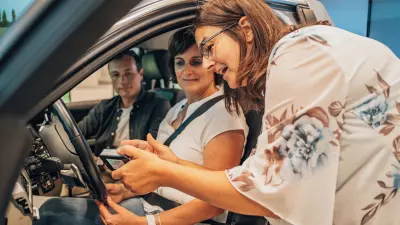
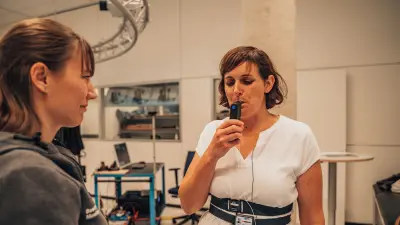
It is shortly before ten o’clock at the Bosch site in Renningen. The driving simulator is quiet and focused. On several screens, the team monitors every movement of the driver: gaze direction, driving behavior, steering movements. The test participant is still sober. A few hours later, the same driver will be back in the simulator. This time, under controlled conditions with alcohol in their blood. Once again, cameras and sensors record every movement. To an outside observer, this may seem unusual.
The study is being conducted by the Cross-Domain Computing Solutions division. It examines how alcohol affects the behavior of drivers and provides important insights for future driver assistance systems. The alcohol detection system itself was also specifically developed at the Bosch Lab, a research and innovation platform operated by Bosch and its scientific partners from the University of St. Gallen and ETH Zurich. Bosch Research, meanwhile, has been researching Interior Sensing for many years – in other words, how sensors and cameras inside the vehicle can capture and interpret information about the condition of the person behind the wheel. This research provides the scientific basis for detecting different forms of impairment.
“Our research comes at exactly the right time. Systems for detecting driver condition are increasingly coming into focus around the world. In the United States, technologies for detecting alcohol-impaired drivers are currently being reviewed by the traffic authority,” explains Hans-Joachim Bieg, research engineer at Bosch Research. “For us, this development confirms that we are researching a topic that is becoming increasingly important from both a regulatory and societal perspective.”
More than alcohol detection
The current study focuses on the effects of alcohol. But at its heart is a much broader research question: How can a vehicle detect when a driver needs support? Alcohol is just one of many reasons why people can suddenly become unfit to drive. Bosch Research is investigating how, in the future, impairment caused, for example, by a medical emergency could be reliably detected. The goal is an interior that understands the condition of the person behind the wheel and can initiate appropriate measures in an emergency — for example, warning the driver, activating assistance systems, or calling for help. “When it comes to detecting health-related abnormalities, the aim is not to monitor people, but to support them in critical situations,” Hans-Joachim emphasizes.

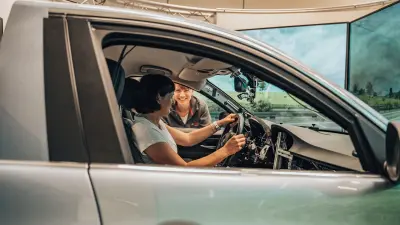

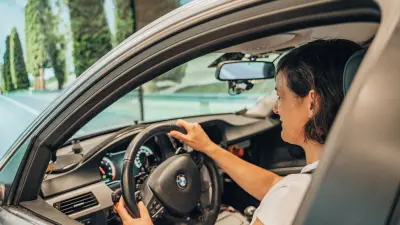

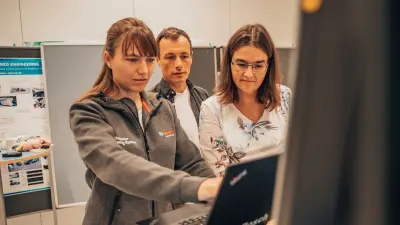
Millions of data points are generated during each test drive. Interior cameras capture eye movements and head position. Cameras and radar sensors inside the vehicle record physiological signals. At the same time, vehicle data such as steering angle, steering movements, speed, and reaction times are recorded. Bosch Research scientifically analyzes this information and uses it to build comprehensive datasets. These form the basis for new AI models and help researchers understand which signals actually indicate impairment.
What Bosch Research has already achieved
Research into Interior Sensing has been ongoing at Bosch Research for more than 20 years. During this time, researchers have conducted numerous studies and gained important insights into which characteristics can indicate fatigue, distraction, or health-related impairments.
The work began with steering-angle-based systems for detecting fatigue, which are already used in series production today. Later, camera-based systems became a focus. They enable more accurate detection of fatigue and distraction. In recent years, Research has also investigated other safety-relevant forms of impairment – for example, those caused by illness or the consumption of drugs such as alcohol or cannabis.
“Our research has shown that the condition of a driver cannot be reliably assessed based on a single signal. What matters is combining different sources of information,” explains Wolfgang Bronner, head of the Bosch Lab. “That is one of the major challenges: distinguishing between individual behaviors and actual impairments while minimizing false alarms.”
The findings from this long-term research program now provide an important foundation for the further development of driver monitoring systems and new applications in the field of Interior Sensing.

From research to application
The current alcohol detection study also builds on these findings. It investigates which indicators of impairment can be reliably detected and how different sensor signals can be intelligently combined.
The biggest challenge is not collecting data, but interpreting it correctly. Not every change in head movement indicates fatigue. Not every delayed reaction is a medical emergency. Researchers are therefore developing AI-based classification methods that combine different sensor signals to derive reliable conclusions about the condition of the person behind the wheel. When detecting the effects of alcohol, for example, information from gaze patterns, eyelid closure, head position, and vital signs can be combined with information about driving behavior.

An important part of the research is also collecting and preparing suitable data. After all, data-driven methods can only be as good as the data they are trained on. In addition to established indicators such as driving and gaze behavior, head position, and eyelid closure, Research is also investigating whether additional physiological data, such as heart or respiratory activity, can improve the detection of impaired conditions.
Bosch Research is not developing these technologies alone. From the outset, researchers have worked closely with the Cross-Domain Computing Solutions business sector. Corporate Research builds datasets, conducts controlled studies, and develops algorithms, sensor fusion, and AI methods, while Cross-Domain Computing Solutions contributes the requirements of future vehicle systems. The collaboration works in both directions: while Corporate Research explores new scientific questions, Cross-Domain Computing Solutions contributes requirements from vehicle development that, in turn, give rise to new research questions.
The current alcohol study is therefore about much more than driver behavior. It provides insights for the next generation of intelligent interior sensing — and for vehicles that will not only recognize where people are looking, but also understand when they need support. The earlier a vehicle detects that someone needs support, the sooner it can intervene, issue a warning, or call for help. This represents another step toward Vision Zero — the long-term goal of making roads safer and reducing road fatalities as far as possible.