Laser in top form
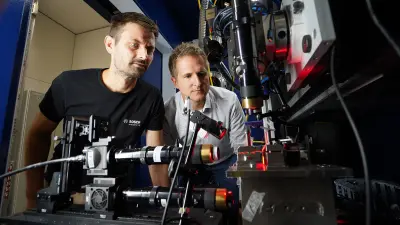
Every washing machine has to withstand thousands of wash cycles over its lifetime. The drum rotates at high speed and is exposed to water, heat and considerable loads. At the same time, customers expect durable appliances at attractive prices, while manufacturers are looking to use materials as efficiently as possible.
This is where a cross-functional team from Corporate Research and BSH, Bosch’s home appliance subsidiary, started its work: Could washing machine drums be made from thinner steel without compromising stability or quality? The solution lay in precisely shaping the laser beam to create a robust weld seam.
Even a small reduction in material thickness can save significant amounts of steel across millions of washing machines. Using less material means lower costs and more efficient use of resources. Initial tests quickly showed that thinner steel sheets were strong enough to withstand the stresses of everyday use. “The real challenge was not the material itself, but the welding process,” explains Peter Stritt. The research engineer leads the project together with Martin Schöpf, Head of the strategic Production Systems (PRS) portfolio.
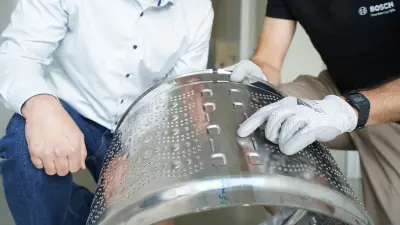
Conventional laser welding processes reach their limits when working with particularly thin sheets. While the laser can melt the material, this can cause spatter or small holes in the weld seam on the inside of the drum.
This is not an option for series production, as the inside of the drum comes into direct contact with laundry. Since no suitable solution was available on the market, the team decided to develop an entirely new welding process. The researchers contributed their expertise in laser beam shaping and in applying physical principles to process development.
Rethinking the laser beam
“The crucial step was not to change the washing machine, but to adapt the laser beam to the specific requirements of the washing machine drum,” says Philipp Krüger. The research engineer contributes his expertise in thin-sheet welding for fuel cells to the project. While conventional processes use a single, round laser spot, the new technology splits the laser beam into several beams using optical elements. Their arrangement is precisely adapted to the material thickness. This distributes the heat more evenly throughout the material, stabilizes the melt pool and prevents welding spatter from forming on the inside of the drum.
The challenge was not to develop a more powerful laser. Instead, the team continued to use existing laser sources and developed an optical solution that shapes the laser beam so that even thin sheets can be welded reliably. “We found the optimal process window in which thin material can be welded reliably and reproducibly,” says Philipp. “That is exactly what makes the difference between an interesting laboratory experiment and a robust series production process.” One of the biggest challenges was reliably defining this process window. Even small changes to the components can affect the quality of the weld seam.
Using physical models and simulations, the team was able to predict how different laser beam shapes would affect the melt pool. This made it possible to narrow down the optical configurations most likely to deliver the best results before conducting physical tests. As a result, significantly fewer practical trials were required. “A comparison from sailing illustrates our physical approach surprisingly well,” explains Peter. “Instead of a conventional monohull sailboat that displaces a large amount of water, our laser beam shape can be compared to a catamaran. Its split profile guides the vaporizing molten metal in a stable flow. Just as water moves freely between the two hulls of a catamaran, the flow in the melt pool is calmed. The result is an extremely stable, spatter-free laser weld.”
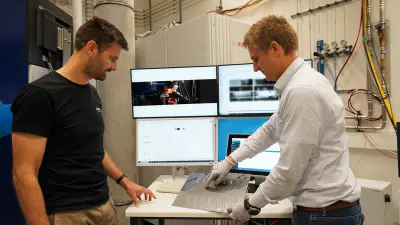
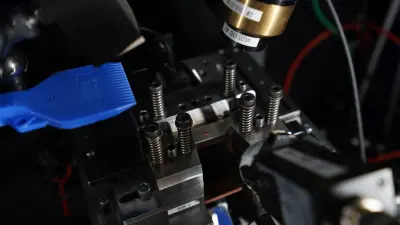
From the outset, Corporate Research and BSH worked closely together. The goal was not only to develop a new welding process, but also to create a solution that could be integrated into existing production lines. Corporate Research developed the physical models and investigated how different laser beam shapes affect the melt pool and weld seam. Together with BSH, the team then transferred these findings into a production-ready welding process.
Because the results could be reproduced reliably, the process was quickly transferred to additional plants. In April 2026, the first production line at the BSH plant in Nauen successfully went into operation. At the beginning of August, the plant in Zaragoza, Spain, followed. Further sites, including in Türkiye and China, are planned.
More impact with less material
“By reliably processing thinner steel sheets, we can save material and costs without compromising the quality or service life of the washing machine,” explains Ralf Rodemann, who is responsible for the project at BSH. At the same time, the technology improves resource efficiency in production. By 2030, the team expects the new technology to generate savings of around two million euros per year. The quality requirements remain unchanged. “With this measure, we are contributing to making washing machines more affordable for our customers,” says Ralf.
But the potential goes beyond washing machines. In the future, the welding technology could also be used for dishwashers, ovens and other products made from thin metal sheets. The research approach could also be applied to numerous industrial applications where high-quality weld seams and spatter-free joints are required.
The project started with a simple question: How can we save material? The result is a new laser welding technology that combines resource efficiency, product quality and industrial manufacturing. For the research team, this is only the beginning. The findings can be transferred to other applications wherever thin materials need to be welded reliably and cost-effectively.