Artificial intelligence takes the test bench
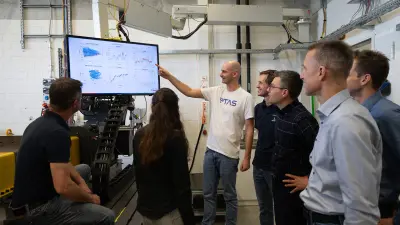
The electric motor is running on the test bench. During development, it is tested under a wide range of conditions — from low to high temperatures and across different operating limits. Every second, new measurement data is generated.
Until now, engineers have decided after each series of tests which experiment to run next. That process required both time and extensive expertise. At the same time, vehicles are becoming increasingly complex, development cycles are getting shorter, and test benches are becoming a scarce resource.
To address this challenge, a team at Bosch Research has developed a new approach: Safe Active Learning. The method helps engineers generate high-quality measurement data faster and more efficiently, accelerating the development of new technologies. During the measurement campaign, the artificial intelligence (AI) independently decides which measurement will provide the greatest additional insight while ensuring that the test bench always operates within predefined limits.
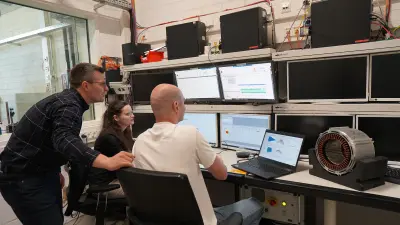
“Test benches are expensive, and every hour counts,” says Daniel Neyer, project manager for Applied AI in Electromobility. “We wanted to find a way to learn as much as possible about a system with as few experiments as possible. The initial motivation for our project came from developing a virtual temperature sensor for an electric drive system. It quickly became clear that the real bottleneck wasn't the models themselves — it was collecting the data needed to build them.”
Smarter measurement planning
Safe Active Learning can be thought of as an exceptionally curious experiment planner. After every measurement, the AI asks itself: Where do I still know too little? That is exactly where it plans the next experiment, while avoiding areas that are already sufficiently understood. The method not only learns from existing data — it also determines which information is still missing. While the electric motor is running on the test bench, the AI evaluates every new measurement and calculates the next meaningful operating point. The newly collected data immediately feeds back into the next decision, making the measurement campaign increasingly efficient and targeted. The goal is not to train the AI itself, but to generate exactly the measurement data needed for reliable temperature models, virtual sensors, or digital twins — with as few experiments as possible.
Safety comes first
Generating valuable insights alone is not enough. In theory, an AI could also select measurements that push a motor beyond its operating limits or place unnecessary strain on the test bench. Safe Active Learning therefore continuously considers all permissible operating limits and selects only experiments that can be carried out safely within those boundaries. Safety is not an additional validation step — it is an integral part of every decision the AI makes. “It was important to us that the AI should not only work efficiently but also ensure safe operation," says Katharina Ensinger, Research Engineer at Bosch Research. "The real challenge was giving the AI enough freedom to learn while ensuring that it never exceeds the defined safety limits.”
Building better data foundations
The development of electric motors served as the first real-world application for demonstrating Safe Active Learning under realistic development conditions. One example is virtual temperature sensors, which estimate temperatures that cannot be measured directly in a vehicle — or only with considerable effort. Reliable temperature information under a wide range of operating conditions is essential for modern electric drive systems. It protects components from overheating and provides the foundation for automated testing and data-driven models.
The more precise the measurement data, the more reliable the resulting models become. “We generate highly informative datasets that can be used directly to develop virtual sensors,” says Matthias Kränzler, Research Engineer at Bosch Research. “Many people focus on improving existing AI models. We started with a different question: How can we obtain the right data faster?” High-quality measurement data also benefits digital twins — virtual representations of real-world systems that accelerate development processes and shift parts of testing into the virtual world.
Developed together
From the very beginning, the new method was a collaborative effort across multiple disciplines. AI researchers worked closely with experts in electric drive systems. “We see ourselves as a bridge between AI research and engineering applications,” says Daniel. “Only through close collaboration with the development teams did we fully understand which decisions an AI should actually make on the test bench and which requirements it had to meet.”
A major milestone was the first long-term deployment on a test bench. Safe Active Learning ran continuously over several days, demonstrating that the method performs reliably under real development conditions.
The results speak for themselves: Depending on the application, individual measurement campaigns can be accelerated by up to 50 percent, allowing development projects to be completed several weeks earlier. But the greatest benefit is not time savings alone. By systematically closing knowledge gaps, the AI generates more informative datasets with fewer experiments. This creates a stronger foundation for data-driven models and enables engineering decisions to be made earlier and on a more reliable data basis.
“We’re not just saving time,” says Matthias. “We’re also creating a much stronger foundation for data-driven development.”
Broad potential
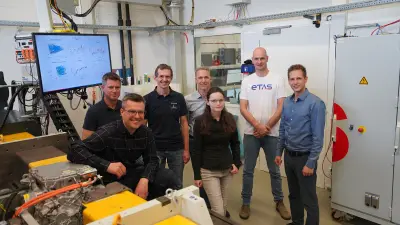
The technology has now reached its next stage of development. Together with ETAS, the method was transferred into an industrial software solution that supports engineers in automated measurement campaigns. Its potential extends far beyond electric drive systems. Heat pumps, combustion engines, steering systems, and many other technical applications could also benefit from intelligent measurement planning in the future.
This highlights one of the greatest strengths of the research approach: a method developed for one specific application can be transferred to many other domains. Safe Active Learning demonstrates how a scientific idea can evolve into practical innovation. What began as a new method in AI research is becoming a tool that accelerates development processes and makes more efficient use of valuable test bench resources.
For the Bosch Research team, however, this is only the beginning. Researchers are already working on extending the approach to additional development tasks. As technical systems become increasingly complex, the ability to learn as much as possible from as few measurements as possible will become even more important. The real innovation behind Safe Active Learning is not that it automatically analyzes measurement data. The breakthrough is that the AI itself determines which information is still missing — and how to obtain it safely within predefined operating limits. It does not replace engineers. It enables them to work more efficiently and reach the right insights faster.