20 years of Bosch Accident Research
Since 2006, Bosch Research’s Accident Research has focused on preventing accidents and reducing their consequences.

Twenty years ago, Accident Research was established as a dedicated field at Bosch Research. Today, Bosch Research is honoring this important field of research at a symposium on the Renningen Campus with partners from academia and industry: More than 100 internal and external participants will look back on the success story of 20 years of accident research at Bosch Research and discuss the future significance of accident research with representatives from government agencies and the automotive industry.
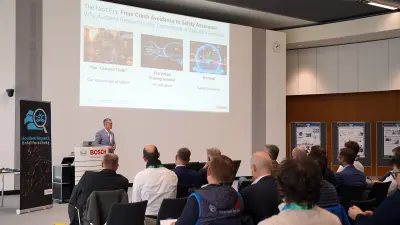
“20 years of dedicated accident research at Bosch a milestone we're proud of. Road safety is deeply embedded in our corporate DNA — a mission Robert Bosch himself pursued. For two decades, our central research organization has been advancing innovations for safer mobility, from cars, buses, and motorcycles to e-bikes,” said Stefan Hartung, Chairman of the board of management, Robert Bosch GmbH.
Bosch's Accident Research team is dedicated to improving road safety worldwide. The goal is clear: prevent accidents, mitigate injury consequences, and save lives. To do this, they analyze crash data, identify risk factors, and develop preventive measures based on their findings. These insights form the basis for Bosch to enhance existing vehicle safety systems and develop innovative technologies, helping to advance both current and future road safety standards.
A 360-degree perspective on traffic
But Bosch accident research goes several steps further. The interdisciplinary team led by Thomas Lich, Senior Expert and Worldwide Team Lead Bosch Accident Research, also supports the product strategy of Bosch's business units and the development of sensors and systems, assesses their effectiveness, and evaluates their performance in the field. In addition, the accident research team contributes to quality management by providing independent analyses for assessing accident severity. Since Bosch has a broad presence in the mobility sector, the accident research team's scope of work today covers various types of vehicles: from e-bikes to motorcycles, passenger cars, and commercial vehicles, all the way to rail vehicles — and all of this on a global scale.
In recent years, Bosch accident research has expanded its focus and now analyzes not only traffic accidents in detail, but also road traffic in general. The research team uses traffic observation data and data from driver assistance systems in the field to derive valuable insights. This enables continuous improvement in the safety of vehicles, vehicle occupants, and other road users across all traffic situations.
Data-based research
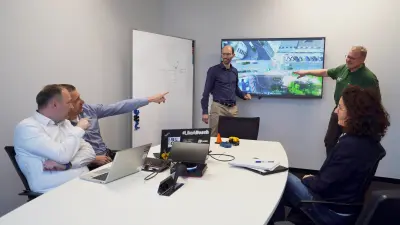
For accident research, Bosch Research relies on a broad data base — extending beyond company boundaries — such as data from the GIDAS project. The acronym stands for German In-Depth Accident Study, a collaborative project founded in 1999 by the Federal Highway and Transport Research Institute (BASt) and the Research Association for Automotive Technology (FAT). The goal of the GIDAS project is comprehensive documentation of traffic accidents involving personal injury in three survey areas in Germany. Through its membership in FAT, Bosch accident research has access to this data. Today, the GIDAS accident database contains details from nearly 50,000 real-world accidents. Analysis of the database reveals, among other things, which situations allow Bosch systems to prevent accidents or mitigate their consequences. Quantitative estimates of how many accidents have been or could be avoided by systems such as ESC, motorcycle ABS, or e-bike ABS are also based on detailed data analysis.
Globally recognized
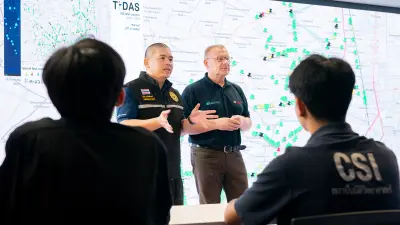
A core principle of accident research is to improve safety for all road users — on a global scale. Over the years, successful research projects have been conducted in the USA, as well as in China, India, Thailand, and other Asian countries. In Thailand, for example, Bosch and the Central Institute of Forensic Science (CIFS) launched a project in 2018 to establish the Thailand In-Depth Accident Science (TIDAS) database. This joint effort documents fatal accidents according to scientific standards, modeled after Germany's GIDAS. The cooperation is currently set to continue through the end of 2026.
In regions with high road safety levels, such as Western Europe, the research focus is currently shifting toward accidents involving property damage rather than personal injury. Bosch accident research is working with the insurance industry, among others, since the increasingly complex sensors in assistance systems often result in high damage costs even in minor accidents.
“With its global approach and the continuous development of data-based analyses in close cooperation with external partners, Bosch Accident Research remains a crucial driver for greater road safety and the improvement of future mobility solutions worldwide,” said Michael Kessler, Executive Vice President Corporate Sector Research and Advance Engineering of Robert Bosch GmbH, at the close of the event.