Urban autonomous driving
Looking back at the STADT:up project
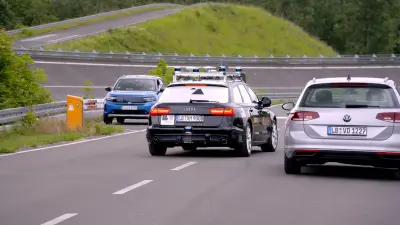
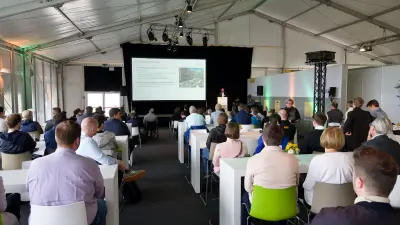
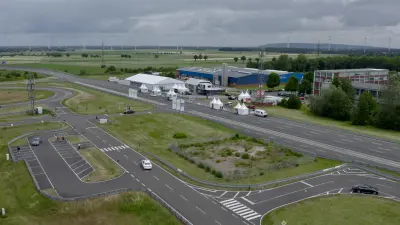
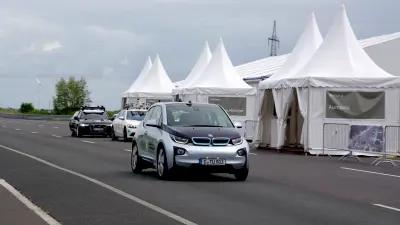
The STADT:up collaborative project, that Bosch Research was a part of, presented the results of three and a half years of joint research and development work at a closing event at the Aldenhoven Testing Center. During the two-day event, representatives from science, politics, industry, and municipalities gained insights into the developed technologies and concepts for fully automated driving in urban traffic. They also had the opportunity to experience the prototypes live during driving demonstrations on the extensive test track.
Automated driving as a key technology for urban mobility
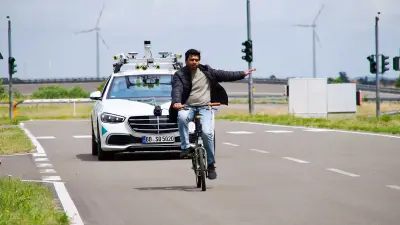
Automated driving is considered a key component of future mobility concepts. While initial highly automated driving functions are already in series production on highways, inner-city traffic continues to pose one of the greatest challenges. Dense and heterogeneous traffic flows, complex intersections, confusing situations, temporary obstacles, and interaction with pedestrians, cyclists, and other road users require particularly robust, predictive, and cooperative driving behavior from automated systems.
This is where the researchers from Bosch and the other partners at STADT:up come in: The aim of the project was to enable automated driving throughout urban traffic and thus permanently relieve the driver of driving tasks — under changing environmental conditions and in complex traffic situations.
Bosch’s comprehensive use of AI for Advanced Driver Assistance Systems (ADAS)
As part of the STADT:up initiative, Bosch has developed an automated driving function that relieves drivers of driving tasks in urban traffic. While the system takes full control of vehicle guidance, the driver is still required to continuously monitor the system. This corresponds to SAE (Society of Automotive Engineers) Level 2 automation. In implementing this automated driving function, Bosch relies extensively on AI — utilizing it for environment perception and data fusion, as well as for behavior prediction and maneuver planning. A significant advancement in the project was achieved, for example, in sensor-based environmental perception, which must function with absolute reliability even under adverse conditions.
To achieve this high degree of robustness, Bosch utilizes an AI that intelligently fuses data from radar and video sensors. This ensures that a precise and reliable overall picture of the environment is generated at all times, even if a single sensor fails or provides misinformation — for example, during heavy rain.
Bosch has also successfully applied AI methods to predict the behavior of other road users and to plan the automated vehicle's corresponding driving maneuvers. This Bosch technology helps the automated vehicle to correctly anticipate the actions of others and to adapt its own maneuvers safely and efficiently in response.
At the same time, the system must ensure that the driver remains ready to take control at all times. To achieve this, an interior camera captures various driver metrics, such as gaze direction, and cross-references them with the current driving situation.
“With STADT:up, we have demonstrated that automated driving can reliably handle the complex and diverse traffic situations in urban areas. The comprehensive use of AI is the crucial key to this,” summarizes Dr. Lutz Bürkle, project coordinator and representative of Robert Bosch GmbH. “At the same time, the user-centered design of human -vehicle interactions plays a decisive role in the safe participation of automated vehicles in traffic. The demonstrations presented today prove that many of the developed solutions have already reached a high level of maturity and can be brought to series production in industrial development projects.”
About STADT:up
The joint project STADT:up (“Solutions and Technologies for Automated Driving in Town”) was funded by the Federal Ministry for Economic Affairs and Energy’s “New Vehicle and System Technologies” funding program. Twenty partners from the automotive industry, supplier sector, technology development, and science and research participated, with Bosch being one of them. With a duration of three and a half years and a total budget of €62.2 million, STADT:up made a significant contribution to the further development of safe, user-oriented, and sustainable automated mobility in urban areas.
The automotive manufacturers CARIAD SE, Mercedes-Benz AG, and Opel Automobile GmbH, as well as the supplier and technology companies Aptiv Services Deutschland GmbH, AUMOVIO SE, AVL Deutschland GmbH, DeepScenario GmbH, Ergosign GmbH, gestigon GmbH, HELLA GmbH & Co. KGaA, Robert Bosch GmbH, Valeo, and ZF Friedrichshafen AG, participated in the project. From the scientific and research sector, the Federal Highway Research Institute ( BASt ), the German Aerospace Center (DLR), the Munich University of Applied Sciences, the Chemnitz University of Technology, the Darmstadt University of Technology, and the Technical University of Munich contributed as partners.