The third major revolution
How Bosch wants to shape the AI transformation successfully and positively through strategic partnerships
2026-06-16
What an opportunity: we are facing momentous change on a scale only a few generations have experienced; a technological revolution with consequences the likes of which have probably only been seen twice before in the history of humankind.
by Stefan Hartung
chairman of the board of management of Robert Bosch GmbH
The first time this happened was around ten thousand years ago, when some people no longer wanted to roam the empty world as nomads. Gradually, more and more groups settled down, no longer living by hunting, but by farming and raising livestock. This laid the foundation for social systems and a productive economy.
The second time was a good 500 years ago, when people realized that Earth was not the center of the universe. Reason and curiosity became increasingly widespread, especially with the help of printing, which was emerging at the same time. Thus began the scientific age in which we still live today.
And now comes the third revolution — and by that, of course, I mean artificial intelligence. AI is taking hold of our everyday lives ever faster and ever more noticeably, and yet I believe that we are only at the beginning of a development that will revolutionize our society and our thinking, perhaps even more radically than we can imagine today. Over the past 150 years, we’ve seen many groundbreaking inventions: cars, airplanes, the internet, modern medicine, and nuclear energy. All changed our everyday lives massively; none changed our world view. However, AI is calling into question the very things that make humanity unique — and by doing so, challenging our view of ourselves.
For us as entrepreneurs, scientists, developers, as people who want to advance, apply, and shape AI, this means one thing above all: it is our responsibility to steer the age of AI in a positive, life-affirming, and liberal direction right from the start. We have to act quickly and strategically at the same time – the cards that are dealt today will determine the game even 50 years from now.
Connecting the physical world and artificial intelligence offers great opportunities
One thing is becoming increasingly clear: if we closely connect the physical world — that is, the world of machines and industry, cars, medicine, or even kitchens — with artificial intelligence, then AI can help us turn standard products into an almost infinite number of individual solutions. In addition — and more importantly — it can make life safer and people more efficient. In mobility, for example, AI is already providing significant breakthroughs, such as in automated driving. Our solutions in this area, especially our ADAS systems, not only think with you, they also think ahead. Reactive safety becomes intelligent intuition; dangers are no longer merely mitigated, but avoided from the outset.
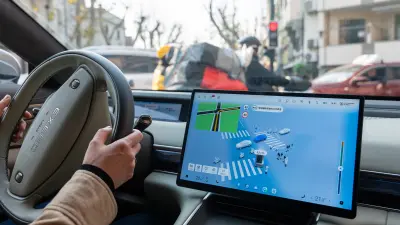
For example, for a few weeks now, we’ve been testing Level 3 driving functions on roads in China. These functions allow drivers to take their hands off the steering wheel and their eyes off the road — even at 120 kilometers per hour. The key to this is having AI in all software modules and combining this with a redundant security architecture. AI will, in conjunction with our sensors, control units, and vehicle computers, make driving a completely new experience — safer, more personalized, and more convenient than ever before.
Up to a speed of 120 km/h
drivers can take their hands off the steering wheel and their eyes off the road with Level 3 driving functions.
The integration of robotics, AI, and sensors takes robots to the next level
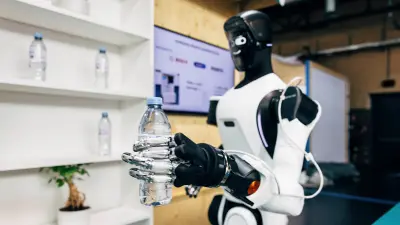
If AI is to develop its full potential, it must recognize and understand its environment as precisely as possible. Intelligence needs sensory apparatus; it must be able to see, hear, and touch. It’s only through perception that knowledge becomes understanding, and only through sensory experience that machines can learn the way humans do. This idea applies to more than road traffic. For a humanoid robot, for example, it has long been easier to speak dozens of languages than to lift a wineglass without breaking it. This is where our ultraprecise MEMS sensors come into play: they measure light, pressure, and movement, and can detect the slightest noise and the smallest changes in the air. Thanks to Bosch sensors, particularly sensitive robots are now able to perceive a touch more or less equivalent to the “impact” of a mosquito putting down a leg. This interlocking of robotics, AI, and sensors will increasingly enable robots to fully perceive their entire surroundings and learn from “experience.” As a result, we will be able to replicate the human body, mind, and senses ever more closely in a kind of “physical intelligence.” What this means for the economy and society is an exciting question, one we’ll also be discussing today.
Our environment is therefore highly dynamic: extraordinary technological progress is taking place against the backdrop of an ever more fragmented world, in which many political achievements are again increasingly being called into question. At the same time, companies not only have to develop their innovations faster than ever before, but they also have to bring them to very different markets at an unprecedented speed. This makes it all the more imperative for companies to look for strong partners if they want to open up new worlds quickly.
Fair and reliable cooperation with partners is anchored in Bosch’s DNA
For Bosch, however, close, fair, and reliable collaboration with other companies is far more than just a key strategy. Partnerships were already a core component of our identity more than 120 years ago, when Robert Bosch joined with shareholders to set up the company’s first sales organizations in France and England. Since then, we’ve worked with numerous companies, large and small, around the world to develop and successfully launch pioneering innovations – from leakproof washing machines and lifesaving braking systems to collaborative software solutions.
What does this mean for the field of AI? It means that here, too, we now need to bear the risks together, institute industry standards, and combine complementary strengths. Our partnership with Microsoft, for example, shows how something like this can work perfectly in practice, even in different sectors. Not only do we use Microsoft’s Hyperscale infrastructure to significantly shorten our development cycles, but we’ve also been working with them on innovations in mobility for some time — examples here include our AI-powered cockpit or various ADAS functions. Such collaborations combine Bosch knowledge across all vehicle domains with the software power of Microsoft.
15 percent efficiency increase
can be achieved in manufacturing with the agentic AI solution Manufacturing Co-Intelligence, while costs can be reduced by up to 30 percent.
Our subsidiary Bosch Connected Industry is also turning to Microsoft technology to further expand its Manufacturing Co-Intelligence portfolio. This agentic AI solution, which we also use in our own manufacturing operations, detects errors in the production process at an early stage and minimizes downtimes. Depending on the application, productivity can be increased by up to 15 percent, while costs are reduced by as much as 30 percent. In the long term, however, much more is possible. The connected factory is increasingly becoming a self-optimizing factory – going far beyond Industry 4.0 and taking manufacturing to a whole new level. AI makes complexity manageable: fluctuations and errors become transparent, correlations become recognizable. The overall process can increasingly be better evaluated and controlled in real time.
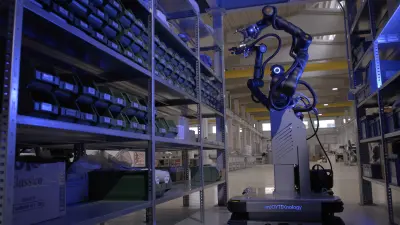
At any rate, we at Bosch are convinced that such strategic partnerships are crucial for achieving business success in an increasingly complex environment. However, this is true only if both sides really benefit from each other.
Acting responsibly — maintaining a balanced approach to regulation
The speed at which AI is opening up new worlds for us is breathtaking. And yet any AI is still miles away from operating at the efficiency of the human brain, especially when you consider the enormous amount of energy, training, and infrastructure that the former currently still requires. This makes it all the more important that we rigorously pursue low-energy solutions while also improving the integrated sensory learning experience of machines and robots. The AI revolution will continue for quite some time yet — far beyond our generation. And like all major turning points, this one will bring not only huge opportunities but some uncertainties as well.
However, I don’t believe that the global age of artificial intelligence can be stopped or even slowed down by regional regulations. AI should of course not be viewed solely in terms of the technology. Its social and political impact is increasingly being taken into account, and rightly so: as with any technology whose consequences cannot be fully assessed, AI needs to be handled with foresight and responsibility.
That responsibility also includes — and here I look at Germany and Europe with a certain amount of concern — keeping regulation from becoming excessive. This is particularly true in a world that is drifting further and further apart without internationally uniform regulation. Or, to put it another way, as long as we can’t rule out the misuse of AI by others, we ourselves must be able to understand and apply AI at the very highest level. From both an economic and security policy perspective, we in Europe should resolutely address the enormous positive potential of AI now and do everything we can to ensure that we don’t fall even further behind in the competition between world regions.
For Bosch, the guiding principle here is very clear. Our strategic imperative “Invented for life” applies without restriction to artificial intelligence, too. It points us in the right direction, demanding that we create technology not for technology’s sake, but in the service of humankind.
And we welcome all partners and customers who want to join us on this journey.