The Bosch Shopfloor Agent
Artificial intelligence for competitive factories


Bamberg, one of Bosch’s largest manufacturing sites, has a long tradition. Spark plugs and state-of-the-art injection systems have been manufactured here for over 80 years. However, the location is continuously evolving and also represents future-oriented topics such as the use of agent-based AI in manufacturing.
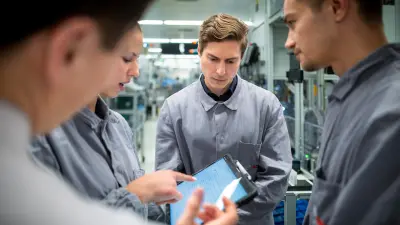
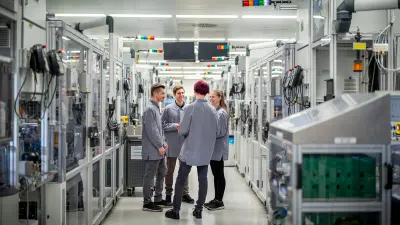
David Haselbauer walks through the state-of-the-art automotive manufacturing facility. The computer scientist knows almost everyone and every corner of “Werkteil 3”, the site’s section 3. The tablet he shows doesn't suggest anything revolutionary. But what the associates at the production machines achieve with it is truly remarkable.
-
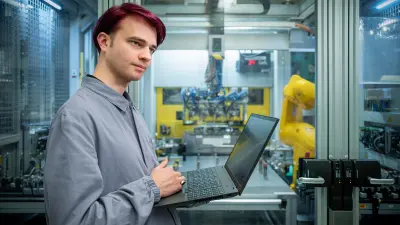
AI expert David Haselbauer in the Bamberg plant during a situation briefing with manufacturing process consultant Leon Keidel -
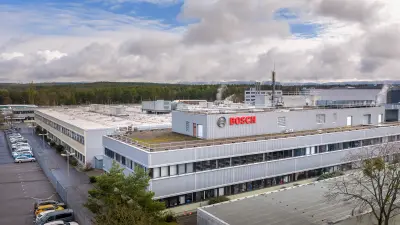
Bosch Bamberg from a bird’s-eye view -
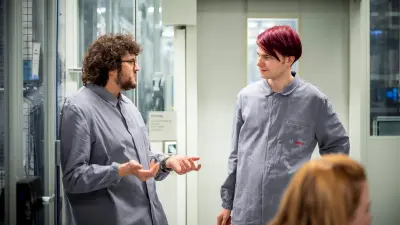
AI expert David Haselbauer in the Bamberg plant during a situation briefing with manufacturing process consultant Leon Keidel
Installed on the tablet is Bosch's Shopfloor Agent, an agentic AI software that helps to restart production facilities more quickly after breakdowns. “The longer a production system is down, the worse it is for output,” says Haselbauer. “We need to reduce cumbersome troubleshooting and its lengthy documentation to the minimum.” The Shopfloor Agent serves a key objective in Bosch's manufacturing, as his colleague Leon Keidel, adds: “Consistent production is a guarantee for high and cost-optimized productivity. AI plays a crucial role here.”
Bosch’s AI solution: The Shopfloor Agent
Philipp Glaser, project manager for agentic AI in manufacturing at Bosch, explains how the solution works. His job is to ensure that AI solutions like the Shopfloor Agent become powerful tools for manufacturing, delivering substantial added value. The Shopfloor Agent makes it possible to identify and fix errors on production machines more quickly, even without in-depth technical expertise — and in any number of languages the AI can be trained on.

Artificial intelligence helps save costs in manufacturing. Associates can use agent AI to solve problems on machinery quickly when expensive downtimes are imminent.
What makes the Shopfloor Agent special is that it acts independently with its stored knowledge, develops strategies for problem-solving, and offers users a solution. The AI supports people and helps to reduce costly downtime. Crucially, as Glaser explains, “Every operator in production must be empowered with this agentic AI to find and eliminate errors.”

Loading the video requires your consent. If you agree by clicking on the Play icon, the video will load and data will be transmitted to Google as well as information will be accessed and stored by Google on your device. Google may be able to link these data or information with existing data.
In the past, associates often relied on the “old hands,” says Glaser. But where is the necessary information located when these employees retire? It's often scattered across different drives or networks. The solution is compelling: Agentic AI documents and stores errors, their sources, and appropriate solutions. With the help of this AI, production facilities can be restarted more quickly. This contributes to maintaining employment, even in high-wage countries like Germany.
“Our goal is for our AI agents to generate measurable value for our customers very quickly,” said Glaser. Since the end of 2025, Bosch has not only been using agentic AI systems in its own plants, such as the one in Bamberg, but has also been offering the technology to external customers.
The effect of AI in manufacturing is indeed promising: The significant acceleration of error analysis and error resolution with the Shopfloor Agent enables annual savings of around €850,000 for each individual Bosch plant by reducing machine downtime.
-
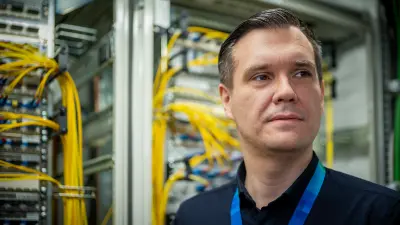
Michael Kolb, Head of Development for AI manufacturing applications at Bosch, recognized the potential of AI in industrial processes early on. -
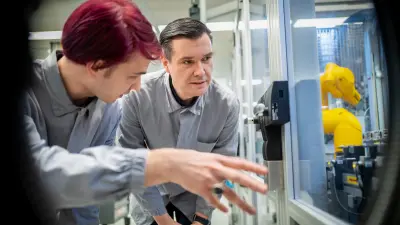
On location in Bamberg: Michael Kolb in conversation with David Haselbauer at the Bosch plant in Bamberg -
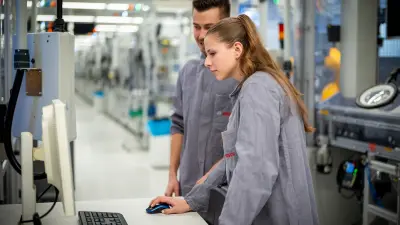
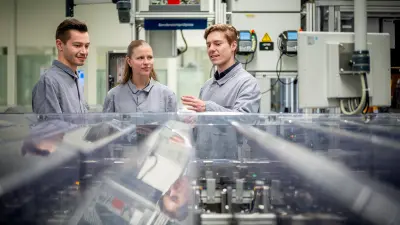
The shop floor agent analyzes error messages and offers context-based solutions to production staff such as Vanessa Krause and Thorsten Pfister.
Acceptance of AI as a goal
For this to work, high acceptance of AI in manufacturing is essential. Michael Kolb, Head of AI development for manufacturing at Bosch, is convinced of this. He has been familiar with the topic for a long time: A patent he helped develop describes the optimization of a Manufacturing Execution System (MES) in manufacturing through agentic AI — the initial spark for the shop floor agent.
For Kolb, Bosch's strength lies not only in AI, but in the unique connection of decades of accumulated manufacturing expertise with state-of-the-art AI technology. "It is Bosch's deeply rooted understanding of production, cultivated over more than 100 years, that transforms AI into a practical, industrial solution," says Kolb. Bosch develops AI not in a laboratory, but from the real world of production — with a clear focus on feasibility, scalability, and measurable benefits.
This very combination creates a genuine competitive advantage for customers: powerful AI that understands production processes, and thinks in an integrated way. Bosch has designed the system so that customers can adapt it to their individual requirements. At the same time, they remain technologically independent and can easily combine the AI with other manufacturing optimization solutions.
With the AI project manager at Sick corporation’s Waldkirch plant
Bosch aims to offer its customers reliable, high-quality performance right from the start. The example of Sick Corporation, a German specialist in sensor solutions, demonstrates that this is possible: Founded in 1946, Sick is a company with more than 10,000 employees and is one of the world's leading solution providers for sensor-based applications in industrial settings.
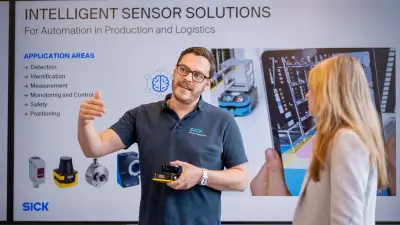
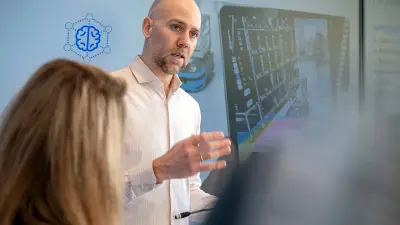
Christiane Becherer is a Senior Specialist for Intelligent Supply Network at Sick. Her focus is on the strategic use of artificial intelligence in the supply chain. In this context, she has taken over project management of the Bosch Agentic AI flagship project at Sick.
According to Becherer, Bosch's Shopfloor Agent is one part of the flagship AI project in Sick's Intelligent Supply Network. During the pilot phase, two agents are being used in production, as the industrial engineer explains. First, the Equipment Ticket Agent helps to create precise tickets. These are the detailed, accurate error messages upon which a solution can be found. Previously, important information was sometimes missing from the tickets, as Equipment Service Software Engineer Marcus Schürmann explains. Troubleshooting could only take place after a time-consuming and successful fault-finding process. “With the Shopfloor Agent,” says Schürmann, “we get to the point that needs to be clarified much faster.”
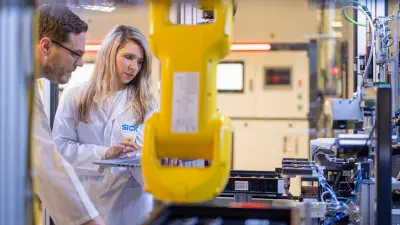
Data bundling, documentation, and targeted solution strategies
The second agent is the Service & Support Agent. This is very similar to the application used at Bosch in Bamberg, where it focuses on providing context-oriented solutions for errors. “The Bosch Shopfloor Agent is very well suited for this purpose,” explains Gabriel Frei, Manufacturing Support at Sick: “It can be used for defective mechanics, problems with sensors or electronics, incorrectly inserted workpieces, or even wear and tear on a production facility that leads to a premature stop, in order to force necessary maintenance.”
His colleague Schürmann emphasizes one important point: AI in manufacturing has the major advantage of providing dialogue-based access to the documentation of previous cases at any time. This makes it easier for support or service associate to quickly find practical solutions. “AI,” says Schürmann, “helps to correctly classify an error and make a targeted suggestion for its resolution.”

For this project, we at Sick can rely on Bosch. Experience in industrial manufacturing and software and AI expertise accelerate collaboration and implementation.
Schürmann’s colleague Frei quantifies the effect for Sick: “If such an AI is sufficiently trained and deployed, then machine failures can be resolved up to ten times faster overall.” Following initial experiences at Sick, the AI solution achieved results on the second day that were on par with experienced experts.
Similar requirements for both the customer and the supplier
But why is Sick AG collaborating with Bosch? Other companies are also now offering AI-based solutions for industrial manufacturing. For Becherer, it's the expertise in manufacturing technology. “Bosch can quickly grasp the use case and proactively offer solutions. Bosch is an ideal partner for us because we share a common understanding of the challenges in future-oriented manufacturing.”
-
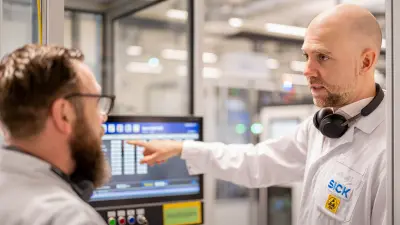
Marcus Schürmann, a software specialist at Sick, regularly visits the production area to learn about the use and functionality of the Shopfloor Agent. -
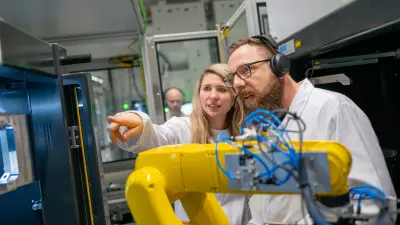
Christiane Becherer and production technician Julian Hensle at a sensor manufacturing plant. -
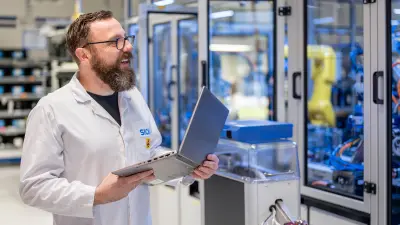
Production technician at Sick, Julian Hensle, is impressed by the Bosch AI solution Shopfloor Agent.