How Bosch is developing its AI talent


Order with a single click and get the goods just a few days later: what feels routine in consumer e-commerce is becoming a growing challenge in corporate procurement and logistics. Instead of simply relying on predictable deliveries, teams in both corporate units now start each day wondering: Will the goods I ordered arrive today? The reality is sobering: orders arrive late, incomplete, or not at all. This uncertainty — often caused by global disruptions such as geopolitical tensions or extreme weather — not only costs time and money but also puts internal production and delivery commitments at risk.
Data instead of guesswork
This is where Juliane Lüder comes in. The 39-year-old data scientist from Abstatt in Germany is developing a solution to make planning more reliable. But she doesn’t have a crystal ball. She relies on data. “Before, around 40 to 50 percent of deliveries went wrong,” says Lüder. “My solution can predict, based on past supplier data, how many parts will actually arrive and how reliable this forecast is.” Using artificial intelligence (AI), she has developed a self-learning model that analyzes historical order data, delivery times, and external factors such as holidays or reported transport bottlenecks.

The result is a forecast that gives Bosch a decisive advantage: the ability to proactively respond to the challenges of unpredictable supply chains and thereby reduce the risks of production downtime or costly emergency shipments. Bosch’s global supply chain management has some 37,000 associates. It is their job to ensure that 250,000 customers are supplied on time every day from around 230 plants. These numbers alone underscore the challenges the corporate unit faces in managing complex supply chains and ensuring seamless collaboration with suppliers and customers.

Loading the video requires your consent. If you agree by clicking on the Play icon, the video will load and data will be transmitted to Google as well as information will be accessed and stored by Google on your device. Google may be able to link these data or information with existing data.
From controller to data scientist
Lüder gained the skills needed for this complex task at the Bosch AI Academy, an internal training program by Corporate Research for AI specialists. Originally trained in business administration and working in the Vehicle Motion division, she applied to the AI Academy with basic self-taught programming skills and an idea for a project around supplier risk assessment. What followed was 18 months of intensive training alongside her regular work at Bosch. She deepened her knowledge of programming, machine learning, and the implementation of AI models. During the project phase, she was able to apply this wealth of knowledge directly to the development of her project. Today, the former controller can proudly call herself a data scientist. “I’ve always been fascinated by mathematics and complex problems,” she says. “But, for a long time, I lacked the confidence to delve deeper into the natural sciences — perhaps part of the reason was that there were few female role models I could relate to.”

We want to build a network of data science and data engineering ‘beacons’ across the company.
Beacons for the data-driven future
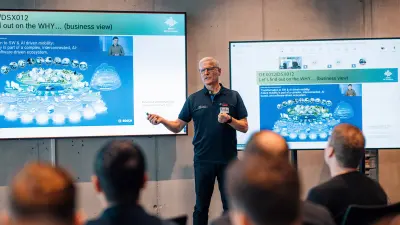
Now she herself has become a role model. Martin Thomas, head of the AI Academy, attests: “Our mission is to upskill associates across all business sectors to become excellent data scientists and engineers.” And this matters more than ever, as AI is already fundamentally reshaping the way people work today. The technology automates routine tasks, creates new job profiles, and increasingly requires associates to make decisions based on data. “Our domain experts in the business sectors are irreplaceable. When we add AI skills to their toolkit, that’s when the best solutions emerge,” says Thomas. “They are our ‘beacons’ and serve as the go-to contacts for colleagues working on data-driven projects.”
So far, some 100,000 Bosch associates have completed AI Academy training. Among them is Juliane Lüder. “The AI Academy gave me the opportunity to take my career in a completely new direction,” she says. The AI Academy offers a wide range of training formats — from basic courses for the broader workforce to tailored expert programs for associates and executives. It also works closely with training initiatives at division level to achieve a broad dissemination of foundational knowledge. In Bosch’s Mobility business sector, for instance, 120,000 associates are scheduled to receive basic training in generative AI this year as part of an initiative started by the Power Solutions division.
100,000
associates have strengthened their skills through the AI Academy.
The return is clear, particularly for the intensive expert programs. These 18-month training programs require a mid-five-figure investment per participant, but it pays off: an internal analysis shows that, within the first five years, the projects delivered by program graduates generate ten times the original training cost in value.
AI as a key technology for a resilient supply chain
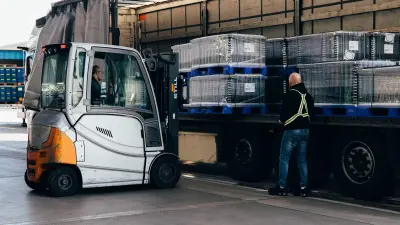
Lüder’s project shows how central AI will become in logistics in the future. At Bosch, it is already being used extensively in this area, from automated internal transport processes using automated guided vehicles to real-time tracking of vehicles and materials. The recent Reinventing Supply Chains 2030 study by the audit and consulting firm PwC Germany also confirms the pivotal role the technology is assuming. According to the study, the surveyed companies are already using AI today for planning, logistics, and risk management, as well as to predict disruptions and respond faster. A total of 80 percent of companies believe that AI will have a positive long-term impact on their supply chains.
It is precisely this positive impact that Lüder now aims to demonstrate in practice. The first opportunity: her solution is already running in the plant in Wroclaw, Poland, where large volumes of production-critical parts arrive daily from hundreds of suppliers. Direct feedback from on-site logistics planning is now the crucial input to refine the AI model further. If this works, the next big step may be on the horizon: rolling out the solution to other plants.
For Lüder, the goal is clear: “The way I see it, the greatest success is when a solution truly helps people in their daily work and makes their lives easier.”
Three questions about the Bosch AI Academy
1. What is the Bosch AI Academy?
The Bosch AI Academy is the company’s internal training initiative designed to build the expertise of associates in artificial intelligence (AI), data science, and data engineering.
2. Who can enroll?
The program is open to all Bosch associates. It offers both open online courses for beginners and advanced learners as well as highly specialized expert programs for aspiring data scientists and data engineers.
3. What makes the initiative unique?
The focus is on practical application. In the expert programs, participants use AI to solve real-world problems in their divisions. This not only builds new skills but also produces directly applicable, innovative solutions.