How we live leadership at Bosch
Isabel, Jessica and Mario offer their insights into our leadership culture
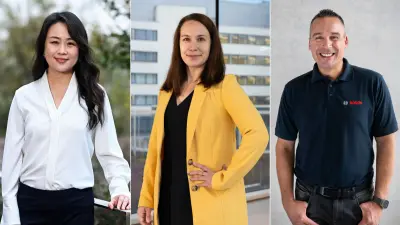
Good leadership provides guidance, builds trust, and enables associates to succeed. At Bosch, we focus on a culture that empowers associates and enables high performance. Isabel, Jessica, and Mario are leaders at Bosch. They work in different departments and countries with diverse teams. However individual their work environments may be, their understanding of leadership is the same: They want to be good leaders who shape Bosch's business success, lead their teams with appreciation, and constantly develop themselves.
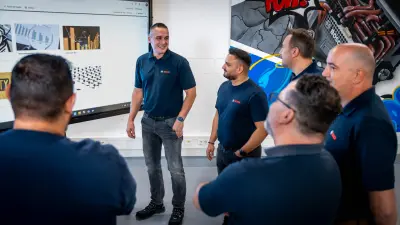
Leadership is individual and can be challenging. For Isabel that's precisely what makes the job so exciting “At Bosch, the associates are diverse. Whether it's different backgrounds, education, or cultures — these differences shape Bosch and add a huge amount of value. I enjoy working with many different personalities. At the same time, it can be challenging to make the most of our diverse perspectives and achieve extraordinary things as a team. That is exactly what motivates me as a leader: I can connect associates, shape collaboration and achieve great things together with my team.” To make this possible, we at Bosch support our leaders. We provide them with three leadership perspectives that reflect expectations and requirements placed on them, offer new food for thought, and thus support them in continuously developing their leadership behavior.
Leadership perspectives at Bosch
Our approach to leadership at Bosch is divided into three leadership perspectives: Leading Business, Leading Others and Leading Myself. The Leadership Requirements give leaders orientation how to lead for performance while focusing on people and leading themselves. By mastering all three leadership perspectives, leaders succeed in their leadership role. At the heart of Leading Business lies entrepreneurial responsibility. Bosch leaders set a clear course by defining goals for their own area. They deliver results that create value for the company in line with Bosch's overall interests. Leading Others puts associates at the centre of attention. Leaders give and earn trust by creating an environment where people speak up and engage in healthy debates. They foster accountability and develop their associates so they can grow and reach their full potential. The perspective Leading Myself requires leaders to reflect on their own personality. They develop themselves through continuous learning in order to grow both personally and professionally. The interplay of the three leadership perspectives ensures that leadership at Bosch is practiced in a holistic way.
Shape Bosch’s success
At Bosch, we pursue clear goals that we achieve together as a team. Our leaders help us to get this right: “The targets are set by the senior management teams for each area. For example, we may need to focus on gaining a foothold in a new business area or expanding production in a country. These are the parameters within which we as leaders at Bosch operate,” explains Isabel. “My job is to work with my team to achieve our goals within the predefined scope. How I accomplish this is entirely up to me, and this is precisely where my leadership role begins. Because my decisions determine whether we are successful as a team or not.”
To achieve their goals, leaders can take a range of actions: “The focus is initially on the associates. Their individual backgrounds bring diverse strengths — which I want to utilise strategically,” emphasises Mario. “Sometimes the team's existing resource isn’t sufficient to reach its goals. This can be due to available capacity or the team's existing expertise. Depending on the task, it can be beneficial to bring in outside knowledge and work on it together. Making these kinds of decisions is also an important part of the leadership process,” reports Jessica.
It may even make sense to deliberately postpone certain set goals, Isabel explains using an example: “Basically, there’s a predetermined profit margin for my department. Occasionally, from a strategic perspective, it can make sense not to reach it — for example, if in doing so we can acquire a new customer and thus generate more revenue and profit in the long term, or enter a new market segment. This is then an investment in the future of my division. Of course, I’m taking a risk with such a deviation from the plan and have to advocate for this approach with my supervisor. But I can always choose a different path if I truly think it’s the better one. I really value this scope for maneuvers.”


Meaningfulness as motivation
Before his team starts working on something, Mario believes it’s crucial to communicate the reasons behind any decisions that have already been made: “I always explain to my associates, what's behind it: Why does this task exist? Why do we need this product or process? And what's the overarching goal?” “This is important for a key reason,” Isabel emphasises. “Because without a rational behind a task, motivation dwindles. I approach a task with more ambition when I know why I'm doing it. Of course, there are also tasks that don't directly contribute to achieving a specific or overarching goal that still need to be done — for example, legally required documentation. And that's perfectly fine. But, wherever possible, I think it's important to understand the connection to the main focus and thus the bigger picture.”
Leading means promoting accountability
Our company founder emphasised the importance of delegating tasks and passing on responsibility to associates. But can everything really be delegated, and is that even sensible? For Jessica, there are three levels: “There are recurring tasks that associates are already familiar with and can complete independently. If they need me, I offer support — but generally, I stay out of it. Then there are new tasks, which means entering uncharted territory. In these cases, I get involved at the beginning and gradually withdraw as the associates have developed the necessary expertise. And of course, there are tasks I can't delegate — for example, this is the case for me with the quarterly reports. There are messages I have to and want to formulate.”
Trust is a crucial foundation for the interaction between leaders and associates. “Trust has two sides,” explains Jessica. “Firstly, I need to trust my colleagues — only then can I delegate tasks with a clear conscience. Secondly, they need to trust me. In my opinion, it motivates them when they know I have put my trust in them: they are more willing to take responsibility and contribute to success.”

Giving and receiving feedback
Giving feedback is an integral part of working at Bosch — whether in regular conversations or specific circumstances. But what does good feedback look like? “In my opinion, feedback should always be as specific and solution-oriented as possible. It's important to me that feedback isn't about assigning blame, but rather a constructive analysis of what happened — always with the goal of identifying areas for improvement,” says Jessica. Isabel deliberately doesn't give feedback immediately: “When I have feedback for someone, I always consciously wait a day. This allows both of us to reflect on the experience and discuss it with some distance,” she explains. “In my view, critical feedback should always take place in a private, confidential conversation. Of course, I also give praise in front of others from time to time — I see nothing wrong with that.”
And what about feedback for leaders? “In China, you do receive feedback — but usually only if you explicitly ask for it. I am very grateful for the feedback from my colleagues, as it helps me to reflect on myself,” Jessica emphasises. This applies not only to China, but also to Germany. “I would say that as a leader, you generally receive less feedback — even though it’s just as important as it is for associates without a leadership role,” explains Isabel. “That’s why I actively ask for feedback, both from my associates and my supervisor. I do this especially when I realise that something hasn’t gone quite right or I feel that I haven’t reached everyone with my messages as I would like.”
Leaders as role models for associates
As you would expect, leaders generally lead by example. But do they see themselves as role models? For Mario, this question isn't easy to answer: “I have high expectations of myself — and I have the same expectations of my associates. Whether it's discipline, reliability, or openness: I can't expect anything from my team that I don't practise myself — whether it's arriving on time for meetings or completing tasks conscientiously. If they do actually see me as a role model, though, I can't say.” Isabel shares this assessment: “I don't see myself as a role model exactly, but rather as someone who serves as a role model. Because, of course, not everything I do is perfect. But I like to lead by example and try things out. And I am pleased when others follow me in this.” For Mario, being an advisor is even more important than being a role model. “I enjoy giving my colleagues tips and advice — not just on work-related topics. Some associates also come to me with their private concerns. This demonstrates a great deal of trust, and of course I want to help.”
Advancing one’s own personal development
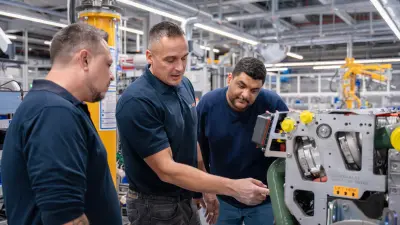
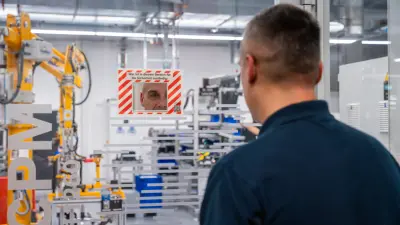
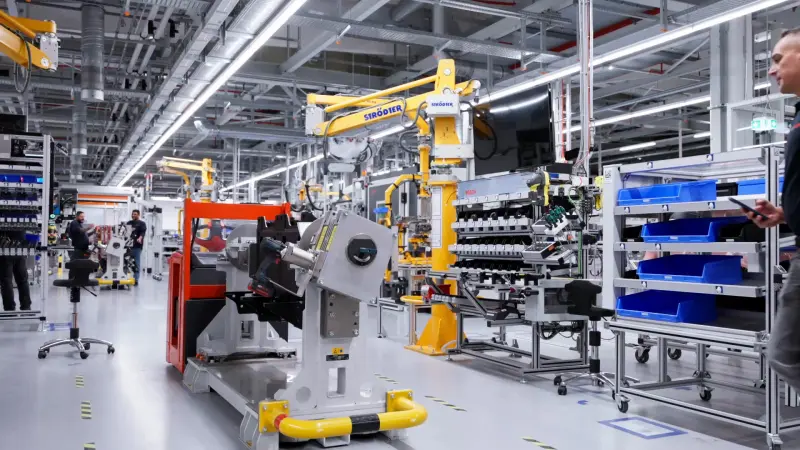
In a volatile world, personal development is crucial for our leaders. Mario, however, isn't just thinking about himself: “It’s satisfying to be able to develop not only myself, but also my team. I'm very interested in new tools and features, and some time ago I had the idea of making our shopfloor paperless. To achieve this, it was clear that I had to learn a lot, including programming. At the same time, I knew I couldn't do it alone. That's why I told my team about my goal, and they were inspired by my enthusiasm. It was a lot of sometimes hard work — but together we did it. Today, for example, there are no more paper notes attached to our machines; instead, QR codes take associates directly to the relevant data. That was a significant team achievement that we are all proud of and that has brought us even closer together.”
Leadership — a matter close to the heart
Leadership inspires — and leadership makes you happy, Jessica thinks. “To be quite honest: For me, it’s fulfilling to be able to help people. Seeing them learn and develop through my support is fantastic!” she emphasises — making one thing clear: Ultimately, it's the interplay of individual associates that defines Bosch. And our leaders play a crucial role in our joint success as a company.

Profile Isabel
Isabel
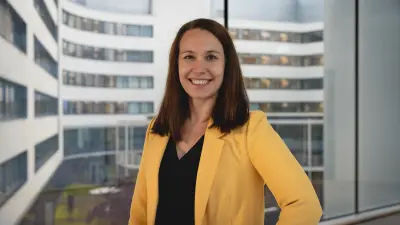
Project Director, BMW eAxle Project in the Electric Axles Product Division of the Electrified Motion Business Unit, Germany
Isabel studied industrial engineering at the University of Stuttgart, Germany, and the University of Córdoba, Spain, graduating in 2011. After graduation, she initially planned to pursue a doctorate in Karlsruhe. However, her future leader at Bosch was so convincing in terms of the tasks and company values that she decided against a doctorate and chose Bosch — joining the central real estate department in 2011. Since then, she has held several positions in various business units and countries. Alongside her career at Bosch, Isabel also completed a part-time Master of Business Administration for Management Finance at the Nürtingen-Geislingen University of Applied Sciences. Following her most recent position as Vice President and Product Area Lead at Power Solutions, she began her new role as Project Director for the BMW eAxle project in 2026.
Profile Jessica

Jessica
Vice President for Corporate Strategy and Business Development, China
After graduating with a degree in International Business from Fudan University in Shanghai, China, Jessica worked for several years at a consulting firm for Bosch. In 2005, she joined Bosch in the strategy department — as the first Chinese associate on the team. In 2010, she moved to the CEO’s office in China, where she worked until 2014. She then returned to the strategy department, where she has held her current role as Vice President since 2018.
Profile Mario
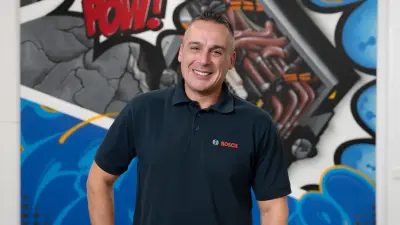
Mario
Shopfloor leader in fuel cell power module manufacturing, Germany
In 1995, Mario began his apprenticeship as an industrial mechanic at Bosch and, after completing his training three years later, he started as a machine operator in production. He gradually took on more responsibility: first as a setup technician, then as deputy shopfloor leader, and from 2010 as shopfloor leader. He continues to work as a shopfloor leader at the Stuttgart-Feuerbach site to this day.