Bosch bets on diamonds
How Bosch is revolutionizing sensor technology with quantum sensors and laying the foundation for their everyday use. An interview with Andre Kretschmann and Tino Fuchs.
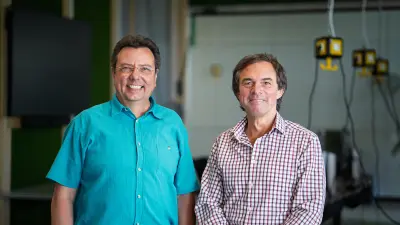
How do you turn raw diamonds into sparkling jewels? Not just through cutting and polishing, but also through innovative technologies. Bosch is betting on diamonds – though not for the jewelry box, but for quantum sensors. These promise a level of precision that was previously unattainable. In this interview, Andre Kretschmann, Head of Advanced Technologies and Micro Systems and Chief Expert for Sensors and Technologies, and Tino Fuchs, Senior Expert and Project Lead for Quantum Sensors at Bosch Research, explain how Bosch intends to use this technology to revolutionize sensor technology, tap into new markets, and lay the groundwork for quantum sensors in everyday life.
Why is Bosch investing in research on quantum sensors?
Andre Kretschmann: Bosch is a pioneer and one of the world's leading suppliers in the field of Micro-Electro-Mechanical Systems (MEMS) sensors. Quantum sensors open up entirely new dimensions here, as they enable measurements with a precision that goes far beyond the capabilities of conventional sensors. They are able to detect the smallest changes in physical quantities such as magnetic fields, gravity, time, temperature, and pressure. The application areas for quantum sensors can be extremely diverse, spanning many industries.
Which industries are those?
Tino Fuchs: In medicine, for example, we can significantly improve diagnostics — such as Magnetic Resonance Imaging (MRI) or Magnetoencephalography (MEG). Personalized medicine will also benefit, as we can detect defects with even greater sensitivity through electrical currents and suggest personalized therapies.
For navigation in automated driving, we are developing systems that are much more precise and can even operate independently of satellites. In process control, the goal is to optimize industrial processes through precise measurements. Even in the geosciences, these sensors are helping us explore natural resources and could even revolutionize the prediction of earthquakes and volcanic eruptions!
Andre: In addition, the development and application of quantum sensors offer significant economic potential. By combining cutting-edge research with the latest technological developments in sensor technology, Bosch can expand its core business while simultaneously tapping into new markets.

What makes Bosch’s quantum sensors so special, and how does the technology work in simple terms?
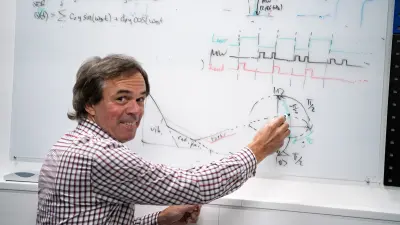
Tino: Quantum sensors specifically utilize quantum phenomena to measure physical quantities with previously unattainable precision. They can detect weak signals like gravitational waves or tiny changes in magnetic fields and are already being used in navigation, scientific research, and medical diagnostics. Bosch is focusing on an innovative technology involving diamonds.
Fascinating — but what do diamonds have to do with sensors?
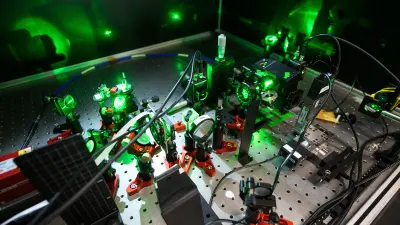
Tino: To turn a diamond into a sensor, so-called “nitrogen-vacancy centers” (or NV centers for short) must be artificially created in the diamond crystal. This is done by replacing a carbon atom in the crystal lattice with a nitrogen atom, while an adjacent lattice site remains vacant. And this is where it gets colorful: if you irradiate the diamond with a green laser, it glows red. Then, to put it simply, when a magnetic field is applied to the diamond, the intensity of the red light changes. We use this effect to determine the smallest changes in the magnetic field. This has allowed us to create a diamond sensor so sensitive that we can measure nerve currents or heart muscle activity without any physical contact.
What contribution did research make to the development and industrialization of these NV (Nitrogen-Vacancy) quantum sensors?
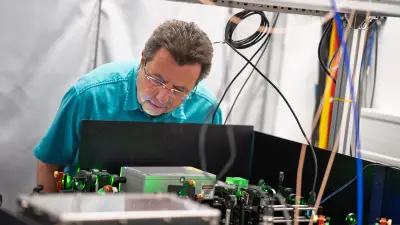
Andre: For a little over ten years, a highly competent research team led by Tino has been investigating quantum technologies emerging in the scientific community and assessing their suitability for scalable industrialization. Since 2017, we have been evaluating these technologies for their potential in Bosch's business areas, focusing primarily on NV technology.
As a research unit, we actively entered the development of NV magnetometers with the goal of transforming large laboratory setups into miniaturized prototypes while maximizing the measurement accuracy of the quantum sensors. Over the years, we have also built a close network with leading NV scientists and diamond manufacturers. The positive and rapid progress led to the creation of an internal Bosch startup within the Bosch Mobility Electronics division, with the goal of systematically advancing the industrialization of NV quantum sensors.
What were the most important milestones on the path from the initial research idea to industrialization?
Andre: We were able to present the first miniaturized NV magnetometer with a green LED as a light source in 2016. However, it was initially no more accurate than a conventional compass. After realizing that we needed to bring the NV centers to an excited state at a much higher rate and had to replace the LED with a laser diode, our first quantum sensors suddenly became a thousand times more sensitive. In 2019, the time had come: the Bosch executives didn't come to our lab; instead, the now-portable sensor came to their office for the presentation (laughs). This was a fantastic moment and was instrumental in Bosch's decision in 2021 to establish an internal startup for the industrialization of quantum sensors.

What was the economic significance of this founding?
Andre: This is how we secure our economic success, by creating a solid foundation of intellectual property on the topic. The last major technical breakthrough wasn't long ago: in February 2025, we managed to set a global sensitivity record in the lab. We can now measure changes in a magnetic field that are 100 million times smaller than the Earth's magnetic field (proudly).
How does Bosch plan to industrialize these technologies and bring them to the broader market? What role did and does Bosch Research play in this?
Andre: As mentioned, a dedicated organizational unit in the form of the startup “Bosch Quantum Sensing” was founded for the new technology and business field of "quantum sensing" to drive the rapid and successful industrialization of NV quantum sensors.
To ensure the startup could operate effectively from the start, experienced researchers supported the team of the Bosch subsidiary with their technical expertise. With the establishment of the joint venture Bosch Quantum Sensing with Element Six, a world-leading diamond manufacturer, we are actively shaping the industrialization of quantum sensing and turning the technology into a business success. This is how we ensure that the expertise from Bosch Research continues to play a central role in the industrialization process.
Why does Bosch continue to research this topic, even though there is already a spin-off?
Tino: Despite the great potential, there are still challenges in the development and implementation of quantum sensors. On one hand, there are technological hurdles, as the production and control of quantum systems are complex and require specialized technologies. On the other hand, NV magnetometers need to be made stable and robust against environmental influences like temperature or vibrations. We are working on quantum measurement protocols that will allow us to almost completely compensate for these influences. The sensitivity potential of NV sensors is also far from exhausted. Theoretically, the detection limit as a magnetometer can be improved by another two orders of magnitude.
What is the next step in the field of quantum sensing?
Andre: We are currently researching another promising topic: so-called functionalized nanodiamonds with NV centers. With their help, it is possible to detect, among other things, free radicals — reactive molecules that can cause cancer — in the blood.
But our diamond sensors can have an impact not only in the medical field but also in highly automated driving. If a vehicle is driving in an environment where neither camera nor radar sensors can be used reliably, such as in darkness or icy conditions, our sensors can provide a solution: they can determine the rotation of an object, expressed as the so-called rotation rate (degrees per second), with great precision. Based on this, we can control whether the car should drive straight, in a tight or wide curve, or determine if it is deviating from its course. These so-called quantum gyroscopes therefore have the potential for Bosch to open up new applications and markets — this applies to automotive as well as to satellites in space, where ultimate navigation accuracy is required.