What do people expect from innovation?
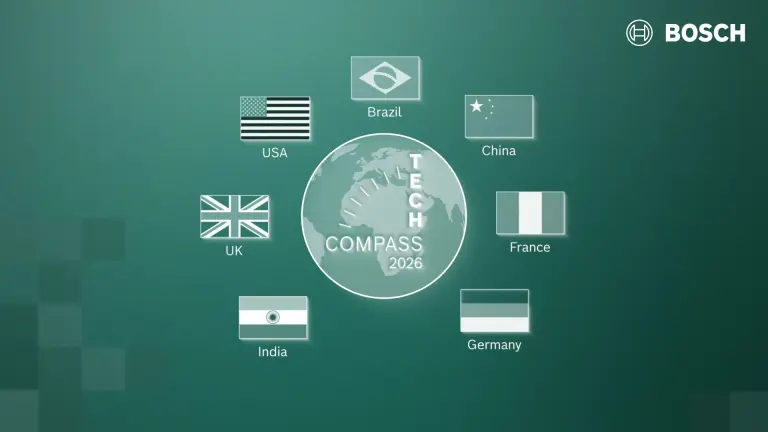
How does the world think and feel about technology? For the fifth edition of the Bosch Tech Compass, we surveyed people across Brazil, China, France, Germany, India, the UK, and the USA to gain a unique 5-year perspective on our evolving relationship with tech.

To understand what technological progress means to people today, the Bosch Tech Compass 2026 places individuals at the center of its research. This global study examines public expectations for innovation in daily life, education, and industry — particularly in an era of geopolitical changes. The findings reveal which technologies are considered most impactful and the diverse, regionally distinct hopes people hold for the future. The research makes one thing clear: innovation must be a global conversation.
5-year tech sentiment: dramatic shifts, surprising stability
Tech optimism rebounds
After a slight dip, public faith in technology is on the rise again. 71% of people believe technology makes the world a better place, up from 69% in 2025. While this is a small rebound, we’re not yet back to the peak optimism of 75% seen in 2023.
Confidence in tech for climate change stabilizes
After a significant drop in 2024, public confidence that technology is the key to combating climate change has leveled off. For the third consecutive year, 71% of people agree with this statement. This stability follows a steep decline from the 83% peak in 2023, suggesting that sentiment has settled at a new, more cautious baseline.
Belief in AI skyrockets
The perceived future relevance of AI has seen a dramatic rise, solidifying its position as the most influential future technology. Globally, 70% now see AI as dominant, a significant leap from just 41% in 2023. This surge establishes AI far ahead of any other technology, with its perceived importance nearly doubling in just three years.
People prioritize health tech innovations — yet differ on the importance of sustainable living

Around the world, people are most eager for innovation in personal health technology. Half of all respondents (50%) say breakthroughs in this area would most meaningfully improve their lives over the next five years. Sustainable living solutions follow at 40%, ahead of privacy and security technologies (34%) and tools for learning and education (26%).
Regional patterns show clear differences. In Western countries, sustainable living innovations play a major role — particularly in Germany, where they rank highest at 52%. They also rank second in the USA at 40%. In contrast, only 28% in China and India prioritize sustainability in this context. While health technology leads in most countries, the value is comparatively lower in India (38%), where people express strong interest in learning and education tools (34%) and personal AI assistants (32%). Meanwhile, China stands out for its strong demand for home-automation innovations (37%), a value significantly above all other surveyed nations.
71%
of people worldwide believe that technological progress makes the world a better place. Optimism is especially high in China at 87%, while in France it remains far more reserved at 53%, reflecting a consistently higher level of skepticism.
Drivers of innovation: Which forces are propelling progress worldwide?

Worldwide, people see three key forces as the primary drivers of innovation: well-educated talent and strong educational institutions (35%), robust research capabilities (34%), and competitive companies (31%). These factors clearly stand ahead of others — government subsidies (24%) and an entrepreneurial culture (16%) are considered significantly less impactful.
Regional differences, however, are substantial: In China, research capabilities are seen as the most important innovation driver (48%). In India, qualified people and educational institutions stand out as the leading force (37%). In Germany (37%) and the USA (41%), competitive companies are considered the strongest engine of progress. In Brazil, natural resource availability plays a more important role (32%) than in most other countries.
It’s not just about technology — it’s about the capabilities behind innovation
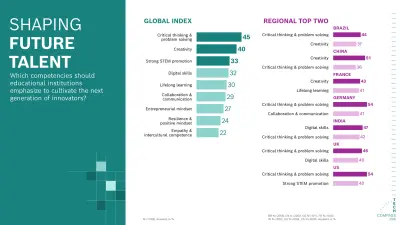
According to the Bosch Tech Compass survey, people see the future of innovation as driven by human skills rather than technology alone. Educational institutions, they believe, should focus primarily on critical thinking and problem-solving skills (45%) and creativity (40%). These two competencies lead the global ranking, followed by STEM education (33%) and digital skills (32%). An entrepreneurial mindset (27%) as well as collaboration and communication skills (29%) are also valued but are considered less essential.
Regional differences show clear priorities:
In Germany and the USA, critical thinking and problem-solving are the undisputed top priority (both 54%). In contrast, creativity ranks first in China (51%) and France (43%). Meanwhile, in India, digital skills take the top position (47%) — significantly higher than in the USA (29%) and China (23%).

Slowing down the pace of technological progress?

The importance of artificial intelligence is rising rapidly worldwide: 70% of people see AI as the most influential future technology — ahead of all other digital innovations. At the same time, confidence in keeping pace with this development is growing: 56% now feel prepared for an AI-driven future, including 82% in India and 76% in China. In Germany, by contrast, fewer than half share this confidence (40%).
At the same time, a clear countertrend emerges: A global majority of 57% support temporarily slowing technological progress until its consequences are better understood. This desire is particularly strong in India (72%), the UK (64%), and the USA (62%); in Brazil, China, and Germany, the figure is just under half.

The true potential of technological innovation isn't found on screens or in virtual spaces. It's revealed where it meets the physical world — where things move and technology makes people's lives easier and safer.
The world’s view on tech: summary of the Tech Compass 2026 highlights
Loading the video requires your consent. If you agree by clicking on the Play icon, the video will load and data will be transmitted to Google as well as information will be accessed and stored by Google on your device. Google may be able to link these data or information with existing data.
Key facts
Study design

In August/September 2025, individuals aged 18 and above in seven countries (Brazil, China, France, Germany, India, the UK, and the USA) were surveyed online by the Gesellschaft für Innovative Marktforschung mbH (GIM) on behalf of Robert Bosch GmbH.
In Germany, France, and the UK, at least 1,000 respondents participated in each country; in Brazil, China, India, and the USA, at least 2,000 respondents took part in each. The selection of participants is representative of each country in terms of region, gender, and age (BR, DE, FR, UK, US: 18–69 years / CN, IN: 18–59 years).