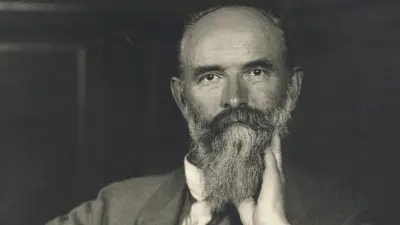
On-site for customers at the Cape
Bosch launches first regional production facility in Brits, South Africa in 1976

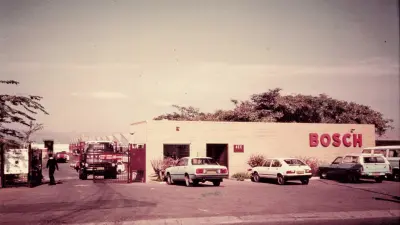
Bosch had already been active in South Africa with a trading partner since 1906. This meant that, in addition to New York, Bosch technology was available outside of Europe for the first time in Cape Town. 70 years later, with the opening of a production facility in Brits, north of Johannesburg, Bosch set another significant milestone that remains important to this day: the first production facility on the African continent.
In a tranquil location
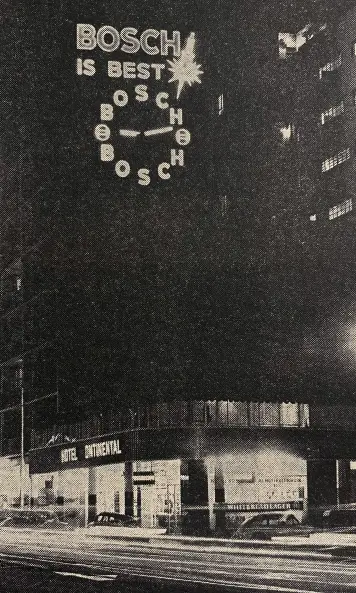
Brits is a small town. A railway station of that name only existed on what is now the Thabazimbi-Pretoria railway line from 1901 onwards; the town itself developed later. Initially, it was characterized by agriculture, but later metal processing and mining industries were added. When Bosch began manufacturing here, Brits had a modest population of 8,000, a number that has more than tripled since then. With the new Bosch production facility, Brits became the center for all original equipment for car manufacturers in South Africa from 1976 onwards, and advertised with the confident slogan: “Bosch is best!”
Prior to 1976, Bosch was represented in South Africa by several companies. These companies distributed various product segments, such as Diesel-Electric Holdings (Pty.) Ltd. and Auto Electrical & Engineering Co. (Pty.) Ltd., to name just the most important. The founding of Robert Bosch South Africa (Pty.) Ltd. in 1965 was a first step towards consolidating the sales structure. This was accompanied by plans for in-house manufacturing, which would provide the organizational foundation for a fully-fledged regional subsidiary.
Race for first place
With this plan, Bosch seized the opportunity presented by the visible market development before other companies took over the dynamically growing original equipment market in South Africa. The South African automotive market had initially remained a marginal player for a long time: Ford had been manufacturing vehicles under license since 1922, and General Motors followed a year later, but these were small production volumes until the 1970s. Bosch itself generated only modest sales because British and US suppliers like Lucas and Bendix were firmly entrenched with Ford and GM. It was only with the arrival of new players like Toyota with its mass-market Corolla, which began rolling off the assembly line in South Africa in 1975, BMW AG, which established a production facility there in 1975, Daimler-Benz AG, which had been manufacturing engines in South Africa since 1973, and also the Volkswagen Group and Alfa Romeo as local manufacturers, that Bosch's own production facility became increasingly urgent.
However, there were two obstacles: Firstly, Bosch's long-standing trading partner, Diesel Electric, wanted to handle production itself. Secondly, its biggest local competitor, the British automotive supplier Lucas, offered to license Bosch technology. Ultimately, Bosch opted for in-house production, and for good reason. After significant initial investment, advance outlays, Bosch was able to maintain control and reap the rewards of its investment.
A sense of new beginnings
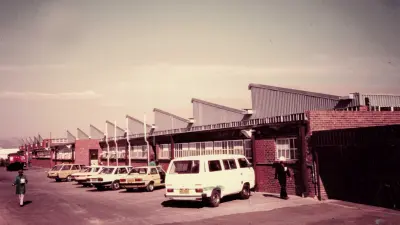
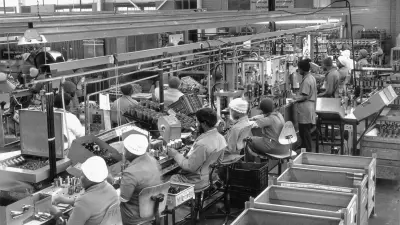
It proved advantageous that Electrical Equipment (AEE), an automotive supplier with Italian roots, had already largely completed the construction of a production facility in Brits, allowing Bosch to acquire the company. Bosch quickly took over the buildings and equipped them with production facilities according to its own specifications. Production commenced as early as July 1, 1976, giving Bosch a competitive edge in the race for customers with their increasing demands.
The figures clearly demonstrate the extent of the increase in demand. While the number of passenger cars manufactured was still below 40,000 in the early 1950s, it had already reached almost 100,000 by 1960, and over 200,000 by the mid-1970s. The advantage for Bosch in securing successful contracts was obvious: Bosch had enjoyed decades of trusting customer relationships with Alfa Romeo, BMW, Mercedes-Benz, and Volkswagen. And Toyota had been a reliable partner since the early 1970s in the joint venture Japanese Electronic Control Systems (JECS), founded in 1973.
Electronics as a new product field
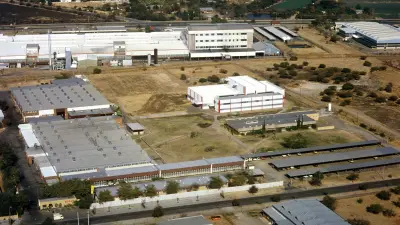
The rise in car sales from the 1970s onward brought Bosch significant revenue increases, confirming that the decision to manufacture in Brits had been the right one: Between the 1980s and the early 2000s alone, Bosch South Africa's sales revenue tripled. The Brits site thankfully still offered space, allowing the company to add electronic control units for the South African market to its classic automotive electrical systems, including starters, generators, and the ignition systems that remain a core product area. In the approximately 3,000-square-meter hall, completed in 1989, control units were produced for both digital engine management systems and the anti-lock braking system (ABS).
Author: Dietrich Kuhlgatz