Early motor races with Bosch
Bosch and the beginnings of motor racing
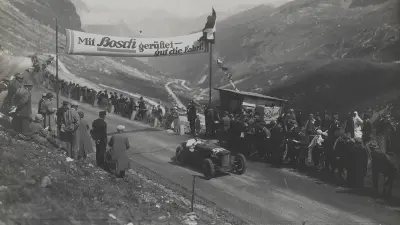
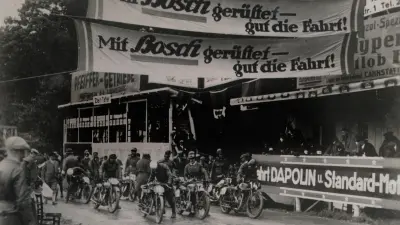
Robert Bosch’s first product developed for the young automotive industry was the magneto ignition. This laid the foundation for his involvement in motor racing – a pursuit that for over 120 years has been shaped by legendary drivers, extreme conditions, and pioneering technology.
Successes in early motor racing
Nice on the Côte d’Azur: it would be hard to imagine a more beautiful place for a motor race, under the spring sun in the south of France. On March 25, 1901, the palm-lined promenade was buzzing with excitement as the fledgling society of automobile enthusiasts gathered. Between the sea view and the engine noise, a race began whose significance would extend far beyond the day itself. Wilhelm Werner won the Nice–Salon–Nice race in a 35 horsepower Mercedes — fitted with a Bosch magneto ignition device. This success marked the beginning of a century-long era full of passion for racing, technical innovation, and countless Bosch successes. For Bosch, this racing success was the most compelling advertisement for magneto ignition, as only quality and precision could prevail under the toughest conditions. At the same time, these systems’ use in extreme situations provided valuable insights that flowed directly into the further development of the products.
The “red devil” as an advertising icon
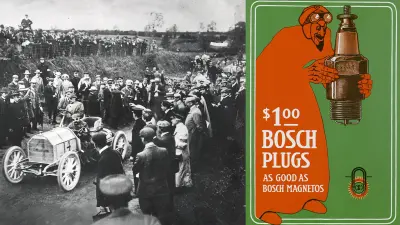
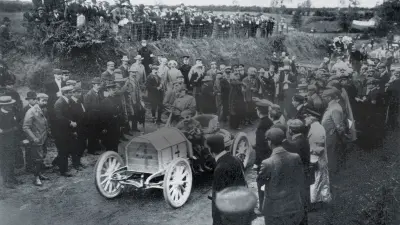
Just two years later, Bosch reached another milestone. The 527-kilometer Gordon Bennett race in Ireland in 1903 confronted twelve drivers with the most adverse conditions. Open vehicles, dust, rain, and slippery roads were a challenge for the men and their machines. But for Camille Jenatzy, the Belgian racing driver, these conditions were only half the problem: shortly before the start, his 90 horsepower Mercedes burned out. A replacement car was found – albeit one that offered a much weaker 60 horsepower. Only in fifth place after the first lap, Jenatzy fought his way forward with his uncompromising driving style and ultimately took a spectacular victory. Just five vehicles reached the finish line; many failed due to technical problems with their steering, rear axle, cooling, or tires. But Jenatzy’s Mercedes ran reliably – not least thanks to its Bosch magneto ignition device. At the victory ceremony, Robert Bosch gave an emotional speech that emphasized the triumph and technical mastery on display in this extraordinary race.
Camille Jenatzy became a legend not only for his victories, but also for his red beard and his daredevil driving style — which earned him the nickname “red devil.” He was the first person to exceed the 100 kph mark in a road vehicle. Bosch recognized the potential of this charismatic racing driver early on. Starting in 1909, the stylized “red devil” could be seen worldwide on posters and advertisements for Bosch magneto ignition devices and spark plugs. At trade fairs, he even appeared as a large three-dimensional figure and became an eye-catcher at every event.
The Bosch Racing Service — development and service right on the track
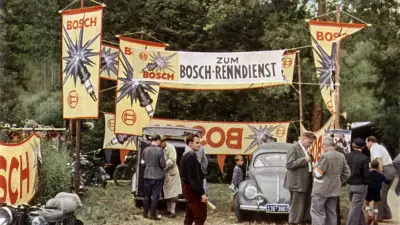
Robert Bosch knew that racing successes weren’t just good advertising, they were also the perfect test bed for new technologies. They were an opportunity to test products under extreme conditions and gain valuable insights for volume production. This is why, as early as 1911, the company was already using its own mechanics at races. They looked after magneto ignition systems and spark plugs — a service that enabled problems to be solved quickly and delivered useful information. This idea gave rise to the Bosch Assistance Service, founded in 1937 and soon renamed as the Bosch Racing Service.
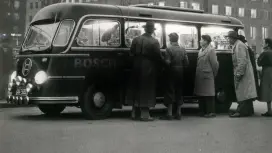
The Racing Service began its work in off-road and mountain races, but from 1938 on also served all the important classic racetracks in Germany and Central Europe. To be in a position to handle all technical requirements, the Racing Service was given a mobile truck-based workshop vehicle in 1938. On board were test equipment, spare parts, and everything needed to service ignition systems and electrical components such as starters and alternators.
Rudolf Caracciola — a Silver Arrows superstar
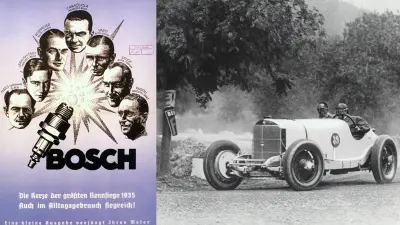
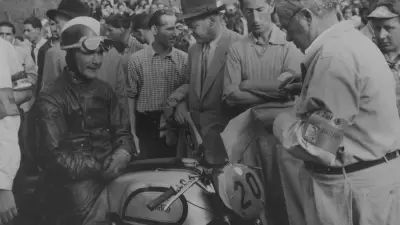
Like technical innovations, outstanding drivers have done much to shape Bosch’s history. One of the most important was Rudolf Caracciola. He received his driver’s license at 15, won his first motorcycle race at 21, and entered motor racing shortly thereafter. Affectionately known as “Caratsch,” he would go on to win 137 victories for Mercedes. His victory at the 1926 German Grand Prix became particularly legendary when heavy rain set in and Caracciola completed an impressive race in the downpour. He shaped the era of the Silver Arrows like no other, won the German Grand Prix six times, and in 1931 became the first non-Italian to win the Mille Miglia. What’s more, he also set speed records — including 432.7 kph on the Frankfurt–Darmstadt autobahn in 1938.
Increasing speed through software
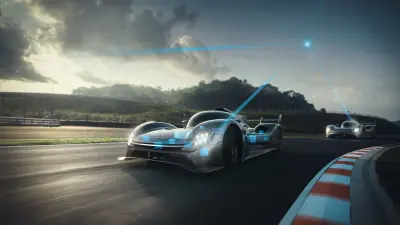
More than a century after these first successes, motor racing has changed fundamentally. What has remained are the extreme pressures, the highest standards of precision, and the will to take technology to the edge. Today, software solutions play a central role. Bosch develops simulation applications that test vehicle performance in virtual environments, as well as real-time analysis tools that optimize race parameters within milliseconds. In addition, there is software for reliable communication interfaces so that teams can stay connected worldwide — a modern-day continuation of the idea that characterized the early Racing Service: maximum support wherever it is needed.
Author: Carmen Senger