Freezers by Bosch
Frozen foods become a part of everyday life
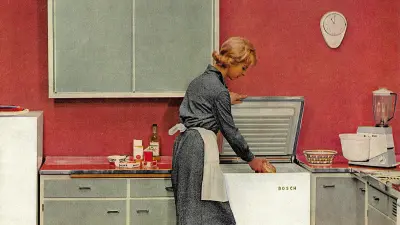
Enjoying summer in winter, having food available at all times – what seems so natural today was almost unimaginable for earlier generations. It wasn’t until the last century that refrigeration technology fundamentally changed the way we handle food, and Bosch played a key role in this shift starting in 1956 with its first freezer.
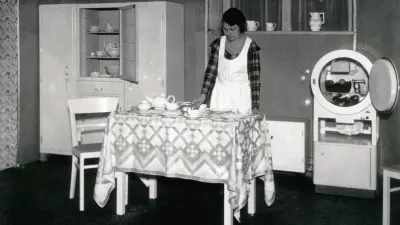
Being able to enjoy strawberries in the winter or frozen vegetables from your own garden is now part of everyday life. For a long time, however, the options for preserving food were limited: fruit was boiled down into jam, vegetables were fermented, meat was salted or smoked. Refrigeration technology ultimately paved the way for a new form of food storage, allowing food to stay fresh and tasty for a long time. Bosch launched an electric refrigerator back in 1933. The first model had a small ice cube compartment – a first step toward freezing food at home. In 1956, Bosch reached a major milestone with the launch of its first freezer.
Freezers gradually expand into the market
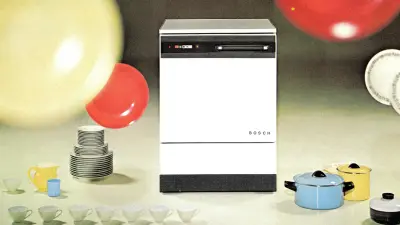
At the Cologne International Household Goods and Hardware Fair in 1956, Bosch introduced its first freezer, the 130 TK. It had a 130-liter capacity and could reach temperatures of minus 18°C – cold enough to preserve meat, fish, vegetables, fruit, or baked goods for several months. Just one year later, the company released a model nearly twice as large. Nonetheless, the freezer initially remained a luxury item. At 1,195 German marks, it cost almost twice as much as a Bosch refrigerator. More powerful compressors, better insulation, and the still relatively low production figures made freezers significantly more expensive.
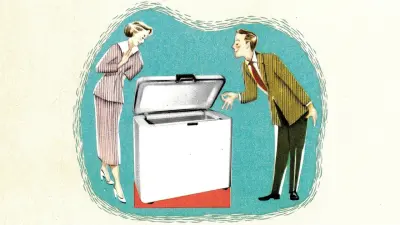
As a result, many families couldn’t afford one of their own. Instead, “community freezers” sprang up in numerous villages. A family would rent a lockable freezer compartment in which they stored meat they butchered themselves or fruits and vegetables from their own gardens. Anyone who wanted to prepare the Sunday roast didn’t go down to the basement, but instead went to their local freezer building with their key.
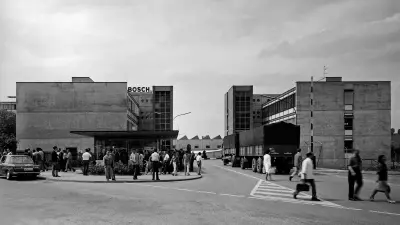
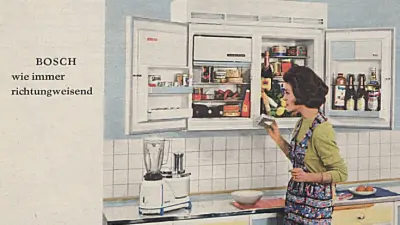
With the economic boom of the 1950s and 1960s, the situation changed drastically. Rising incomes and larger homes made freezers affordable for more and more families. At the same time, Bosch continuously expanded its product line – from wall-mounted refrigerators with large freezer compartments to the first freestanding freezer and on to compact tabletop freezers.
From luxury item to everyday helper
Freezers really took off in the 1970s. They were on many households’ wish lists, right after cars and home furnishings. This high demand was due to three key developments: frozen foods became increasingly popular, supermarkets expanded their product lines, and more and more women entered the workforce. Freezing food made everyday life considerably easier and made larger shopping trips and stocking up on supplies much simpler. In addition, the freezing method proved to be particularly gentle: food can be stored for months while largely retaining its flavor, texture, and many nutrients. By the 1980s, about seven out of ten households in Germany owned a freezer.
The face of Bosch home appliances
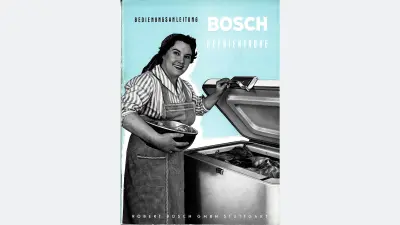
Gertrud Schmidt
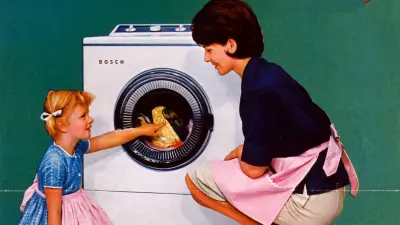
The extent to which freezers could make everyday life easier was evident long before their widespread adoption, as illustrated by Bosch associate Gertrud Schmidt. In the 1950s, she became the face of numerous Bosch cookbooks, instruction manuals, and advertisements. As a single mother, she earned enough extra income through her modeling work to provide her two sons with a good education. Her story is representative of many women who have had to balance family and career. For such households, freezers helped make daily life more flexible and made it easier to stock up on food.
Quality, efficiency, and responsibility
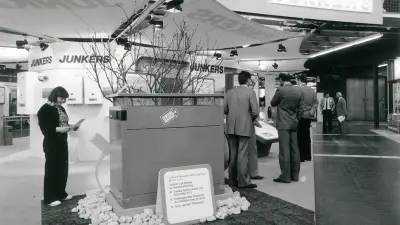
As sales figures rose and export markets expanded, Bosch also continued to refine its testing procedures. The company reached a milestone in 1972 at its Giengen plant with the commissioning of a Siemens process computer. For the first time, tests on refrigerators and freezers were evaluated using computer-aided methods. The new technology automated measurements, increased testing capacity, and enabled tests that went far beyond the German industry requirements in effect at the time. Among other things, the tests examined the refrigerant charge, energy consumption, performance during a power outage, and the ability to reach at least minus 18°C when fully stocked and at an ambient temperature of plus 32°C. Additional heat tests conducted at an ambient temperature of 43°C simulated use in tropical export markets and ensured that the devices would operate reliably even under extreme climatic conditions. The process computer thus played a key role in further improving the development, quality assurance, and international competitiveness of Bosch freezers.
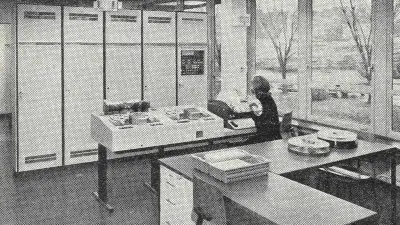
Following the oil crises of the 1970s, energy consumption came into sharper focus. Thanks to improved insulation, more efficient compressors, and optimized refrigeration cycles, Bosch was able to reduce the energy consumption of its freezers by 36 percent between 1978 and 1985. A few years later, environmental friendliness also became more of a concern. As early as 1986, Bosch began investing in the development of CFC-free refrigeration technologies and started mass-producing refrigerators and freezers equipped with them in the early 1990s.
Where efficiency meets comfort
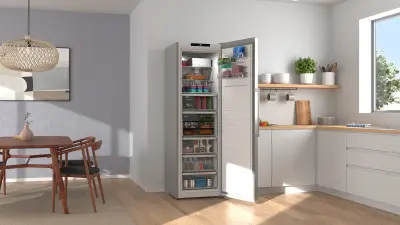
Freezers operate around the clock, which is why their energy efficiency is so important. In 2012, Bosch began introducing new generations of freezers with an A+++ energy efficiency rating, the highest at the time. In parallel, convenience and storage space were becoming a higher priority. Today, thanks to new, flexible features, freezers make it particularly convenient and easy to store a wide variety of foods. Opportunities are also being identified to reduce energy consumption further, including through pioneering vacuum insulation panels and innovative speed-controlled compressors. In addition, modern freezers offer significantly more usable capacity than earlier models while having nearly the same external dimensions. Today’s XXL freezers have a capacity of up to 471 liters – more than three and a half times that of the first Bosch freezer introduced in 1956.
Author: Carmen Senger