A small component with a big impact
The Bosch lambda sensor

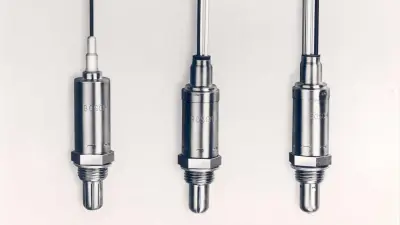
As the inventor of the lambda sensor, Bosch is one of the pioneers of exhaust-gas treatment in cars. This unassuming sensor quickly became an indispensable component in vehicles with combustion engines. Since going into large-scale production in 1976, it has played an outsize role in making combustion more efficient, lowering emissions, and ensuring compliance with exhaust-gas regulations.
In late 1960s California, the summers were shaped not only by flower power but also by poor urban air quality. A new type of smog was causing breathing difficulties and headaches. It didn’t take long to find the cause: nitrogen oxides and hydrocarbons, which react under the influence of sunlight to form harmful ozone. As the number of cars grew, so too did exhaust emissions. In 1970, the U.S. Environmental Protection Agency announced a significant tightening of exhaust-gas emission limits — and Bosch began developing an innovative technical solution.
Catalytic converter and lambda sensor
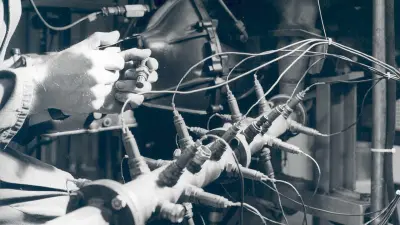
Bosch quickly realized that enhancements of the engine alone wouldn’t be enough to comply with the new limits. The most effective way to reduce emissions was to use a three-way catalytic converter. What does a catalytic converter do? When an engine fails to combust fuel completely, it emits carbon monoxide, nitrogen oxides, and hydrocarbons — all of them harmful pollutants. The three-way catalytic converter transforms them into harmless carbon dioxide, water, and nitrogen.
For optimum conversion, however, the ratio of air to fuel has to be at the ideal value of lambda = 1 across all the engine’s operating states. This value is achieved at 14.66 kilograms of air per kilogram of fuel.
Initial testing showed that it wasn’t possible to maintain the ideal lambda value of 1 without controlling the air-fuel mixture. But the prerequisite for such mixture control was continuous measurement of the lambda value during engine operation — and that called for a sensor. As no such sensor existed at the time, Bosch launched a broad-based research project. The objective was a lambda sensor that would measure the oxygen content of the exhaust gas and transmit this value in the form of an electrical signal to the control unit of the injection system. This information could then be used to regulate the amount of fuel injected and achieve the best possible air-fuel mixture.
The start of development
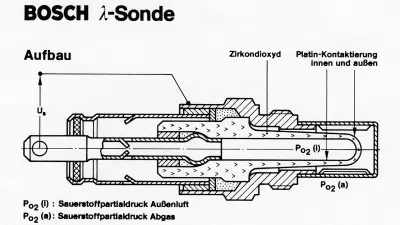
Bosch’s research department had been using an “electrochemical cell” to measure the oxygen content in gases since around 1963, initially with a view to measuring oxygen levels in the drying oven during battery production. The company’s many years of experience in manufacturing spark plugs also proved useful when working with the ceramic material. Meanwhile, the load conditions that the new lambda sensor had to withstand — including exhaust gas temperatures of up to 1,000 degrees Celsius, vibrations, as well as lots of dirt and water from outside — demanded countless development steps in the selection of materials for the sensor and in its design and testing.
The road to large-scale production
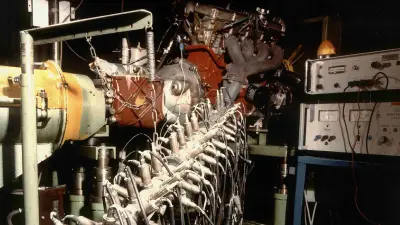
In the fall of 1971, the first lambda sensors to be manufactured in-house were tested — and the results were disheartening. The laboratory prototypes withstood the load for just two hours. Various thermal problems were to blame. It wasn’t until 1975 that a service life of 250 hours was finally achieved, corresponding to a mileage of 20,000 kilometers.
The customer for the first volume application was the Swedish manufacturer Volvo, which equipped its 240/260 series for the U.S. market with Bosch lambda sensors in 1976. This had a huge impact: in view of the low emission levels achieved — so low, in fact, that they would satisfy the even stricter requirements of upcoming legislation — the U.S. automaker Ford agreed on a supply contract with Bosch in 1977 for three million units per year.
Innovations and break-even
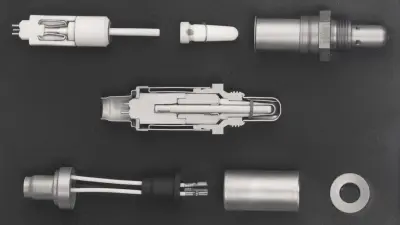
By 1982, Bosch had fully developed a new variant that offered a key advantage: it held a small electric ceramic heating element within. This meant that the lambda sensor would work reliably just 30 seconds after starting a cold engine. The addition of heating paved the way for further design improvements, such that the service life was subsequently increased to around 160,000 kilometers.
Thanks to these innovations, Bosch was able to expand its market position. It was in 1986, as the ten millionth lambda sensor rolled off the production line, that this technology finally broke even and all the investments since the first prototypes were built, 15 years earlier, paid off.
Faster, more compact, more versatile
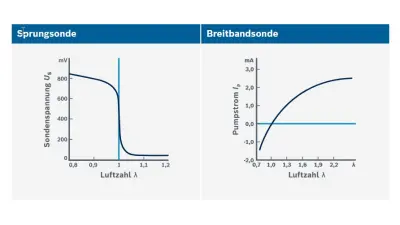
Bosch launched an advanced planar lambda sensor in 1996. Conventional lambda sensors were switching-type sensors, with a characteristic output signal jump at lambda = 1. Bosch’s new wideband sensor had a continuous characteristic curve with a greatly extended measuring range. One way to further reduce consumption and emissions was by using very lean mixtures with high excess air and a lambda value greater than 1 in partial-load operation. In this situation, the wideband sensor was able to reliably supply its readings to the engine control unit. As the catalytic converter temporarily stored oxygen, it could continue working in the optimum range. This resulted in possible applications for advanced gasoline engines, but also for economical diesel injection systems.
The planar wideband sensor’s measuring cell was constructed using layered technology with zirconium oxide ceramic films and integrated heating, which made the lambda sensor shorter and meant it was ready for operation more quickly. Subsequent generations of both switching-type and planar sensors continued the trend: they became even more compact and robust, took more accurate readings, and responded more quickly after a cold start.
Only seemingly unassuming
As unassuming as it may seem, the Bosch lambda sensor has been playing a major part in reducing emissions ever since it first appeared in 1976. More than 1.7 billion units have been produced in total over 50 years. No matter whether it’s two-wheelers, cars, or trucks; gasoline, diesel, or gas engines; gas heating systems; or even some ovens: they all rely on the Bosch lambda sensor.
Author: Bettina Simon