Tradition and new beginnings: Bosch and Southeast Asia

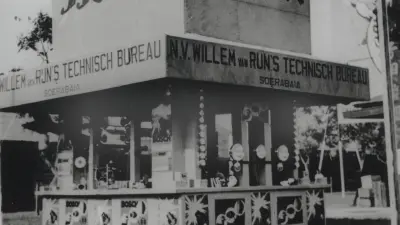
“We would like to assure you that we have consistently been very impressed with your products, even in our tropical climate.”
This was the positive feedback sent by the general representative of Bosch on Java, part of modern-day Indonesia, to Stuttgart during the 1930s.
Bosch has since been active in Southeast Asia for over a century. Our long-standing presence continues to be defined by deep cultural understanding, close partnerships, and an ability to adapt technologies to local needs. Today, the region is home to over 700 million people and represents one of the world’s most dynamic economic areas.
The early years
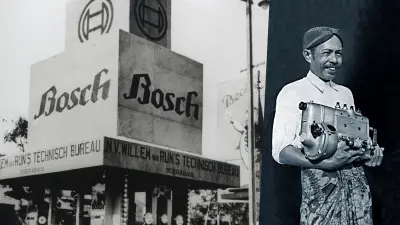
The activities of Bosch in Southeast Asia started in Indonesia. Bosch products were first sold in Surabaya, on the island of Java, as early as 1919. Bosch was then represented by the trading company Van Rijn. The first world war had just ended and Bosch had to reconstruct its international business. It was during this phase of development that Bosch also moved into Malaysia, Singapore and Thailand (1923), as well as the Philippines (1926).
Bosch was still dependent on a relatively small product portfolio of entirely automotive technology. This made expansion into new markets extremely important. Bosch applied the same strategy in these countries as in all markets where there were still relatively few cars, which made the right tactics imperative.
The approach was to use well-established trade partners with an excellent local knowledge. The Southeast Asian countries remained mainly sales markets for Bosch products until the 1960s, when the company took further development steps. Malaysia, with highly qualified workers and a well-developed infrastructure, had turned into an important production location for consumer and automotive electronics after 1970. This prompted Bosch to set up production lines in Penang, which churned out cameras and car radios.
Singapore enters

Next to Malaysia, Singapore gradually became a hub of global trade for Southeast Asia in the 1980s. Bosch founded its own trading company in 1972, and thus took over Bosch’s operations from its trading partners. After that, a central sales office for Southeast Asia was opened in 1988, and in 1997, Bosch set up regional headquarters in Singapore to coordinate business activities in the region.
During the 1990s, Bosch also established regional companies in countries with strong emerging economies such as Thailand and the Philippines. In the last decade of the century, regional offices, companies and sales partners have also been set up in Cambodia, Indonesia, Laos and Vietnam, along with new production locations in Indonesia and Vietnam. Today, the office in Singapore looks after Bosch in Southeast Asia and Oceania, overseeing business strategy, sales and regional coordination across all Bosch’s business sectors.
A fast-growing and future-focused market
Southeast Asia is a strategic growth region for Bosch. With a young population, steady economic growth of around 4-5 percent annually, and accelerating urbanization, the region offers strong demand for innovative technologies.
“Southeast Asia is a diverse and resilient region that presents enormous potential. Bosch’s long history here gives us a deep understanding of the market, and a responsibility to grow together with our partners, customers, and communities. By investing in local talent, local production and locally relevant technology, we aim to continue shaping a more sustainable, connected and inclusive future for Southeast Asia,” shares Robert Hesse, President of Bosch in Southeast Asia and Oceania.
Over the years, Bosch’s engagement in Southeast Asia has evolved from simple sales distribution to multi sector integration - from manufacturing and semiconductors to corporate research. As the Southeast Asian economies continue to mature and pursue digital transformation, Bosch’s localised investments, talent development programs, and integrated supply chains position it as a long standing partner in the region’s future growth.
Author: Dietrich Kuhlgatz