Safer roads, smoother rides: The power of predictive cloud-enabled driving
Bosch Research Blog | Posted by Melanie Gallant, Tobias Frye, Laura Beermann, Christoph Mark, Kevin Schmidt, Paolo Pazzaglia, 2026-10-23

A vehicle brakes. The car behind reacts. Then the next one brakes a little harder — and suddenly, a traffic jam forms seemingly out of nowhere. These so-called traffic shockwaves are a consequence of how vehicles traditionally interact: each car perceives its surroundings locally and reacts to what happens in front of it. But what if vehicles could communicate their intentions instead?
At Bosch Research, we are investigating how cloud-based cooperative driving can enable vehicles to anticipate each other’s movements, helping to reduce traffic shockwaves, improve energy efficiency and make automated driving safer.
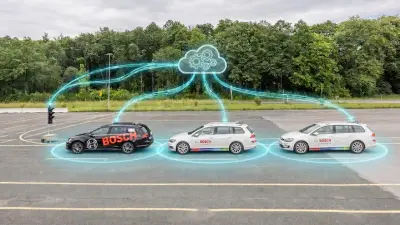
Our latest work focuses on predictive cloud-based control, where vehicles actively share their planned acceleration or deceleration. By communicating intentions rather than merely reacting to noisy measurements from onboard sensors, connected vehicles can anticipate traffic flow changes, eliminate traffic shockwaves, and make driving maneuvers safer and seamless.
This research is a key component of the Bosch project “CUBE-C — Cyber-Physical Systems (CPS) Cloud Continuum” , embedded within the European initiative IPCEI-CIS (Important Project of Common European Interest for Next Generation Cloud Infrastructure and Services). Supported by the European Union and national governments, IPCEI-CIS aims to establish a decentralized, energy-efficient, and multi-provider cloud-edge infrastructure. Within this framework, Bosch Research is developing methods, modules, and tools to realize safety- and time-critical applications in a cloud-edge continuum. By shifting complex cooperative coordination tasks from the vehicle's onboard computer to high-performance remote nodes via 5G connectivity, we significantly reduce the vehicle's local energy consumption and computational load while making use of the low, reliable latencies required for real-time safety functions.
Our approach is centered on a cooperative longitudinal control algorithm running on an edge/cloud server to enable smarter, more energy-efficient driving decisions. Instead of merely reacting to a preceding vehicle's braking maneuvers, our Connected Adaptive Cruise Control (CACC) system proactively utilizes shared predictive data retrieved via the cloud. Because connected vehicles continuously transmit their planned accelerations or decelerations, surrounding cars receive immediate anticipatory information. This real-time coordination allows predictive control to optimize acceleration and anticipate braking, which ultimately reduces fuel consumption, mitigates safety hazards, and prevents the “stop-and-go” traffic waves that lead to congestion.
What hinders us from offboarding control loops?
We have all been there: dropped calls, delayed texts, and “No Service” symbols on our smartphones — in the digital world, data gets lost or runs late. On the phone, it is an inconvenience. In safety-critical control, it is a risk we cannot ignore.
In order to guarantee reliability despite real-world timing uncertainty, we don’t treat communication challenges as exceptions. Instead, we design our control algorithms around them, obtaining safety and robustness by design . To build this directly into our algorithms, we use distributionally robust designs that safeguard system behavior against varying delays and packet losses. Combining these ideas with AI-enabled predictive control makes it possible to optimize future vehicle paths under a spectrum of potential latency profiles.
However, static robustness alone cannot cope with shifting network conditions. We tackle dynamic challenges with dynamic solutions: our algorithms continuously adjust to shifting network conditions and probabilistic communication gaps in real time. This includes knowing exactly when it is necessary to degrade safely from a cloud-based to a local fallback controller.
The bottom line: Instead of hoping for a perfect connection, we design control systems that thrive with an imperfect one.
Autonomous driving does not happen in a vacuum; it unfolds on real roads with unpredictable signals, mixed traffic, and sudden dropouts. Our algorithmic framework is designed to handle three critical operational scenarios:
- Fully connected scenarios: In an ideal environment where all vehicles are connected, cloud-based control increases safety and efficiency by accounting for surrounding cars' motion and optimizing predicted distance, speed and acceleration profiles. Uncertainties such as potential spikes in communication delays and changing road conditions are taken into account in the control framework.
- Mixed-traffic scenarios: Because the transition to connected driving will be gradual, our methods safely operate alongside non-connected, human-driven vehicles by relying on robust on-board sensors and enhancing efficiency by using cooperative cloud-based control where available.
- Fallback scenarios: If cellular network connectivity is temporarily lost, e.g. in a tunnel or a signal dead zone, the controller seamlessly and safely transitions back to local vehicle control relying only on on-board sensors without any disruption to passenger safety.
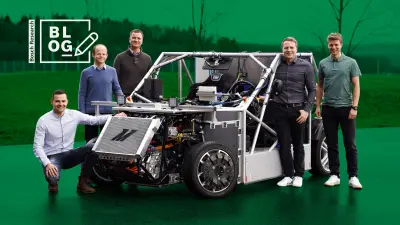
To validate our theoretical models and bridge the gap between simulation and reality, we recently transitioned our designs to the test track for preliminary trials using prototype vehicles as an experimental test case.
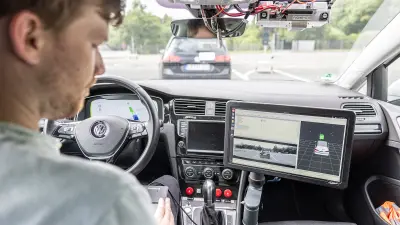
These early tests focused on basic cooperative driving maneuvers, such as connected acceleration from a standstill at a traffic light and subsequent braking to a full stop, while maintaining a velocity-dependent safety distance. To evaluate our algorithms, we captured quantitative state information such as velocity, acceleration and distance to the preceding vehicle using on-board sensors. For qualitative analysis, we also recorded bird's-eye videos from a drone. To see our controller in action, watch the video showcase below demonstrating how it successfully coordinates the vehicle motion during a connected group start at a traffic light under varying network quality.
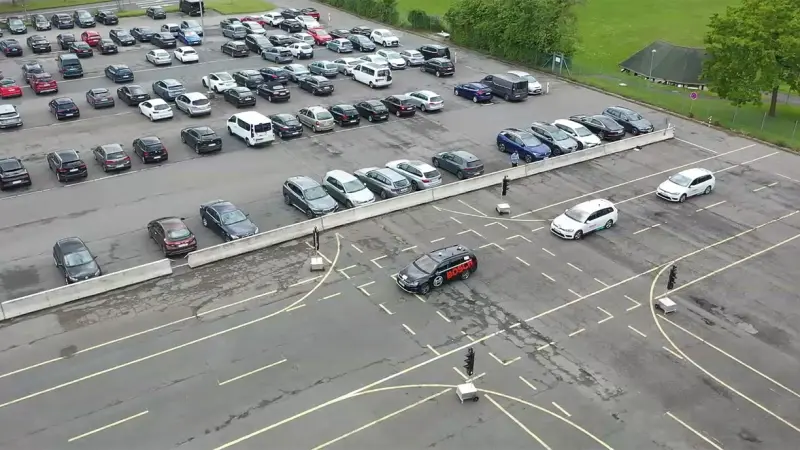
Our preliminary test runs demonstrate that cooperative longitudinal control is a highly promising path toward safer and more efficient traffic. By shifting the paradigm from reactive-individual to proactive-cooperative driving, we are paving the way for the future of automated mobility.
Author 1

Melanie Gallant
Melanie is a Ph.D. candidate specializing in control theory for real-time systems. Her research targets stochastic and distributionally robust control for switched systems, specifically tackling the effect of varying delays on control loops. By developing strategies that are robust to these fluctuations, she enables more reliable and performant applications under uncertain timing.
She completed her master’s in electrical engineering and information technology at the Karlsruhe Institute of Technology (KIT) and is currently pursuing her Ph.D. in computer science at the Saarland University in collaboration with Bosch Research.
Author 2

Tobias Frye
Tobias is a Research Engineer at Bosch Research dedicated to shaping the future of mobility. He focuses on connected driver assistance systems and Vehicle-to-Everything (V2X) technologies to make our roads safer and more efficient. With a comprehensive understanding of end-to-end architecture, Tobias seamlessly integrates in-vehicle data with cloud-based control applications. He earned his Master’s degree in Computer Engineering from the University of Hannover.
Author 3
Laura Beermann
Laura is leading the research group “Scalable Software Platform Systems”. She is a project lead & product owner in the “Information and Communication Technology” (ICT) portfolio at Bosch Research, too. Her work ensures that complex engineering processes are accelerated and improved through virtual validation and simulation by implementing advanced testing methodologies and enhancing simulation quality.
Since Laura joined Bosch in 2019, she has worked with many different divisions ranging from automated driving, vehicle motion, braking systems up to cyber-physical systems and heat pumps.
Laura holds a diploma in mechanical engineering from the KIT where she also holds a PhD focused on thermal turbomachinery.
Author 4

Christoph Mark
Christoph is a research engineer specialized in the control of stochastic dynamical systems and decision-making under uncertainty. His research focuses on bridging the gap between theory and practice by developing provably safe, distributionally robust control algorithms that ensure the safe operation of physical systems despite imperfect models and uncertain environments. At Bosch, his work is applied to various domains such as advanced driver assistance systems, braking systems, and heat pumps.
Christoph holds a master's degree in engineering cybernetics from the University of Stuttgart and a Ph.D. in control engineering from the University of Kaiserslautern.
Author 5
Kevin Schmidt
Kevin is a research engineer and project lead at the “Information and Communication Technology” (ICT) portfolio specializing in uncertainty-aware systems. His work ensures that complex, AI-driven systems are safe, robust, and reliable. By implementing continuous, automated validation and enhancing simulation credibility through uncertainty quantification, his team transforms virtual testing into dependable product release decisions. This accelerates development without compromising quality. These methods apply across the entire Bosch portfolio, including vehicle motion control, braking systems, electric drives, and heat pumps.
In his MSc Kevin focused on system dynamics and control. He holds a PhD in engineering cybernetics from the University of Stuttgart.
Author 6

Paolo Pazzaglia
Paolo is a research engineer with main expertise in control and real-time systems. His research topics target the design and analysis of distributed and embedded control applications, with a particular focus on guaranteeing joint timing and functional constraints.
At Bosch Research, his work helps bridge the gap between theoretical real-time control methods and actual hardware deployment, especially in the context of networked vehicle control and new braking architectures. By investigating the effects of various types of delays and faults on stability and performance, he helps design cyber-physical systems that are robust to real-world timing effects and adaptable in case of overloads.
Paolo holds a master's degree in Robotics and Automation Engineering from the University of Pisa and a Ph.D. in Emerging Digital Technology, curriculum Embedded Systems, from the Scuola Superiore Sant'Anna in Pisa.