Robert Bosch becomes a factory owner
The emergence of industrial production at Bosch

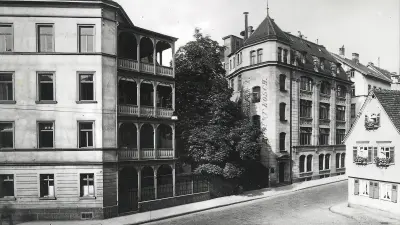
Today, Bosch has locations all over the world. But it was on a garden plot in Stuttgart that Robert Bosch built his first factory. He planned the building with determination and foresight, thereby laying the foundations for both modern manufacturing operations and lasting business success.
Difficult beginnings
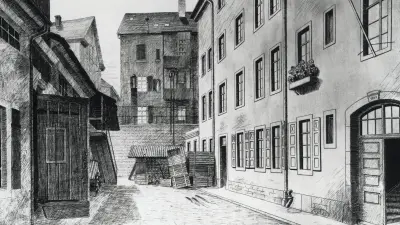
Around 1900, Robert Bosch had 45 associates working in extremely cramped conditions in his workshop. With electrification gaining ground, new orders were pouring in, and at the same time magneto ignition devices were starting to account for most of the young company’s sales. Robert Bosch consistently invested the earnings his company generated in modern machinery and better equipment — an expression of his entrepreneurial vision. But despite this, in spatial terms his business had always been on a provisional footing: the workshop had moved several times within Stuttgart, but each time to rented premises.
While the manufacturing facilities were bursting at the seams, the company’s reach was already expanding beyond national borders. In 1898, Bosch had opened a sales office in the United Kingdom, its first outside Germany, and was already generating more than 15 percent of its sales abroad — a considerable proportion for a company that didn’t yet have its own factory premises.
The business moves into a factory of its own
By the turn of the century, Robert Bosch had built up enough assets to forge a new path for his business. In March 1900, he purchased a house with a large yard not far from his previous location, which was to form the basis for the new factory. In letters to friends, he proudly stated that he was now a “houseowner” and predicted that his investment would pay for itself within a few years.
Not only was the purchase an expression of economic success, it was also a strategic move: the previous workshop was too small and didn’t allow for efficient workflows. The everyday reality there was still no different than in a traditional artisanal workshop: Robert Bosch assigned tasks to his mechanics and fitters daily, ranging from precision mechanical repairs to complex installations at the customer’s premises. For urgent orders, he called back associates who were working in the field, and he pitched in himself when it came to dispatching orders.
However, as demand grew — especially for magneto ignition devices — the limits of manufacturing products individually became increasingly apparent. Robert Bosch recognized early on that only modern manufacturing technology could ensure long-term competitiveness. Industrialization called for a rethink of production structures, a clearer division of labor, and more space.

A modern industrial building comes into being
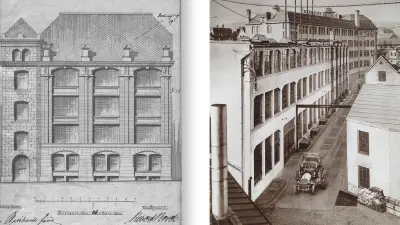
In planning his new factory, Robert Bosch set store by the latest principles of construction and production. The building was the first in Stuttgart to be built of reinforced concrete — an innovative construction material for the time, which offered fire safety, high load-bearing capacity, and large spans. Since the design largely did away with supporting columns, the resulting open spaces could be put to more flexible use. Robert Bosch knew that a factory had to serve business purposes first and foremost.
At the same time, he attached great importance to the impression that the building’s exterior would make. Instead of a “plain shed,” the factory was given a Renaissance-style sandstone façade so it would blend harmoniously into the residential area. On the inside, the factory offered bright, spacious, and well-ventilated rooms — ideal conditions for productive and high-quality work. This demonstrated Robert Bosch’s understanding of modern corporate governance, which combined technical innovation with social aspects.
Large-scale manufacturing begins
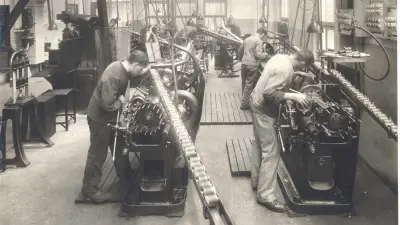
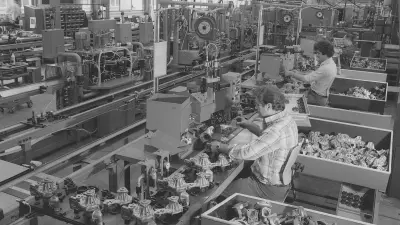
On April 1, 1901, not quite 15 years after the company was founded, 45 associates moved into the new “Elektrotechnische Fabrik Robert Bosch” (Robert Bosch electrical engineering factory). Large-scale production of magneto ignition devices began that same year — a decisive step from artisanal business to industrial enterprise. The new premises meant production processes could be organized more systematically, and it considerably increased efficiency.
There were also changes in how human resources were organized. For a long time, Robert Bosch had been a technician, salesman, and correspondent all in one — but managing this workload for the long term was too much. The arrival of new associates made for a more nuanced division of labor between the commercial organization, sales, and development. This created a modern corporate structure that facilitated further growth.
Robert Bosch had originally planned to rent out individual floors of the new factory, but demand for his products was so great that he needed all the space for his own manufacturing. A second factory was built in the backyard of the first as soon as 1905. These expansions marked a decisive milestone: what had been a small courtyard-entrance workshop became an expanding industrial enterprise — and the foundation stone for a company with locations worldwide.
Building Bosch’s first factory was more than just a construction project. It symbolized the transition to a new industrial age: one characterized by technical innovation, organizational modernization, and entrepreneurial vision.
Author: Carmen Senger