Environmental protection along the value chain
We leverage the innovation potential of Bosch and our partners to protect the climate, save water, especially where it is scarce, and strengthen the circular economy.
Climate action
Climate change is one of the biggest challenges facing humanity: stopping it is a task for society as a whole.
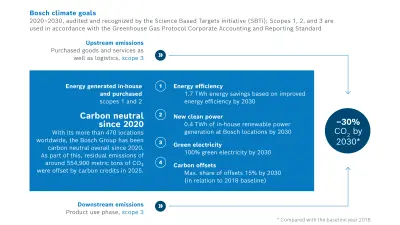
As early as 2020, the Bosch Group with its more than 470 locations worldwide has been carbon neutral overall (scope 1 & 2)*. Four levers were used to achieve carbon neutrality: increasing energy efficiency, generating our own energy from renewable sources (new clean power), purchasing electricity from renewable sources (green electricity), and — as the last resort — using carbon credits to offset residual CO₂ emissions. In 2025, residual emissions of around 554,900 metric tons of CO₂ were offset by carbon credits.
At the same time, we also want to reduce emissions produced outside Bosch’s direct sphere of influence (scope 3), for example at suppliers, in logistics, or when our products are used. Our aim is to reduce these upstream and downstream emissions by 30 percent in absolute terms by 2030, compared with the baseline year 2018 — irrespective of our company’s growth.
The Science Based Targets initiative (SBTi) endorsed our climate targets for the 1.5 degree pathway. This means that Bosch has science-based climate targets for the entire value chain — from purchasing to the product use phase.
The independent Science Based Targets initiative (SBTi) regularly evaluates Bosch’s climate targets for scopes 1 through 3 on a scientific basis every five years, most recently in 2025. This assessment covers the absolute reduction of CO₂ emissions in scopes 1 and 2 as well as scope 3 emissions, energy demand, and the procurement of green electricity. Our science-based climate targets and their validation status (“Targets set”) are listed in the SBTi’s Target Dashboard.
EY GmbH & Co. KG Wirtschaftsprüfungsgesellschaft (EY) conducts an annual assurance engagement of our Sustainability report. Among other aspects, EY reviews the key performance indicators relevant to the achievement of our climate targets (scopes 1 and 2), including energy demand, greenhouse gas emissions (scopes 1 and 2), new clean power, green electricity, and carbon offsets. These are the metrics used to continuously monitor progress toward our climate goals. Additional information about our climate action activities, as well as the independent auditor’s assurance report, can be found in the Sustainability report 2025. Content that has been subject to assurance is identified in the report by a blue check mark (pp. 28–30).
The calculation of our scope 3 emissions is reviewed annually by TÜV Rheinland Energy & Environment GmbH (TÜV). TÜV confirms that the collection of data and the calculation of climate-relevant greenhouse gas emissions (CO₂e) are scientifically substantiated, reflect the current state of the art, and provide a reliable basis for measuring, reporting, and reducing greenhouse gas emissions in the future. An excerpt from the current verification report can be found here.
* Scopes 1, 2, and 3 are used in accordance with the Greenhouse Gas Protocol Corporate Accounting and Reporting Standard. We have taken into account the effects of CO₂ and of other greenhouse gases, as well as climate-relevant substances, to the extent that these are of relevance for the analysis. To enable comparability between the climate impact of the various greenhouse gases and substances of relevance for the climate, emissions are presented in CO₂ equivalents. For ease of reading, we use the terms CO₂ and CO₂ equivalents synonymously.


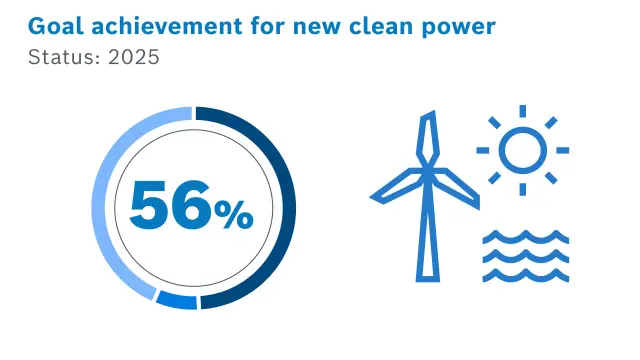
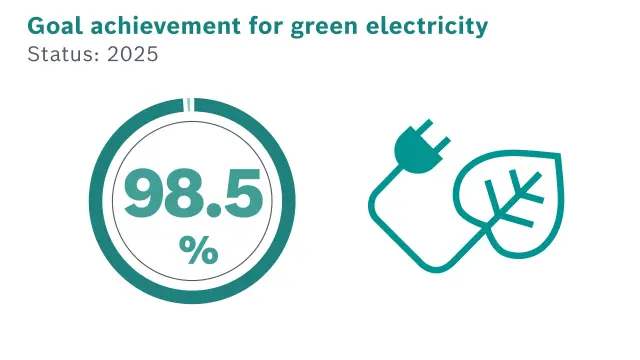

Implementation of the four levers
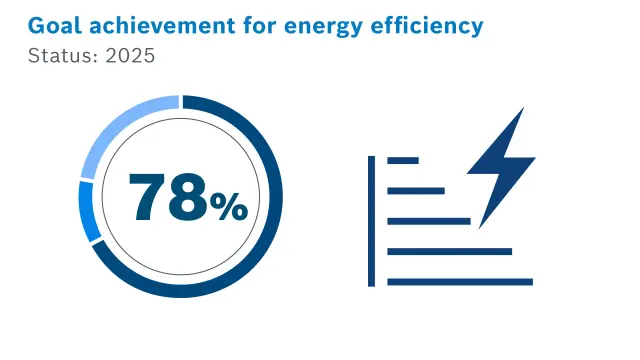
To achieve the group-wide targets set for 2030, all Bosch divisions are pursuing staggered annual targets. These targets are set based on the energy demand and the savings achieved so far. Targets are cascaded down to individual company locations at the discretion of the respective divisions and the degree to which targets are achieved is tracked centrally.
On this basis, those responsible at the divisions and company locations make decisions to implement measures to improve energy efficiency or to initiate projects to generate their own energy regeneratively. As the availability and quality of green electricity and the legal conditions for the expansion of renewables differ between countries, the regional organizations are responsible for green electricity and new clean power projects. Carbon offsets are regulated centrally to ensure the quality of projects. The sites themselves order and transact the measures.
Climate action across the entire value chain
We want to shape climate action beyond our immediate sphere of influence (scopes 1 and 2) and, where possible, also systematically reduce upstream and downstream emissions (scope 3). We aim to cut these by 30 percent in absolute terms by 2030 compared with the baseline year 2018. In this process, we are focusing on the categories that make up around 98 percent of our scope 3 emissions: upstream emissions in the Bosch value chain primarily concern purchased goods and services as well as logistics. Downstream emissions are mainly caused by the use of our products.
Purchased goods and services
To reduce upstream CO₂ emissions in purchasing, all divisions use a standardized steering concept that includes two instruments:
- General target agreements with suppliers to reduce their CO₂ emissions, preferably in combination with a specific SBTi commitment.
- Specific agreements for focus materials such as steel, aluminum, copper, and plastics as these materials are responsible for a significant portion of CO₂ emissions in the supply chain.
Since 2018, we have reduced upstream CO₂ emissions in purchasing from approximately 34 million metric tons of CO₂ to 26.9 million metric tons of CO₂ in 2025.
Logistics
In logistics, we aim above all to reduce CO₂ emitted during the transport of goods. We have a variety of instruments at our disposal here:
- Optimizing freight
- Reducing air transport
- Improving packaging design in order to use less packaging material, storage space and transport capacity
Since 2018, we have cut our transport-related CO₂ emissions by around 36 percent, down to 1.9 million metric tons of CO₂ in 2025.
Product use
Around 90 percent of scope 3 emissions are generated during the product life cycle. We currently see the greatest potential for lowering CO₂ emissions in those divisions in which products require a relevant amount of energy, that is above all mobility, thermotechnology, industrial drive and control technology, and household appliances. The focus is on three leverage points in each case:
- Boosting energy efficiency
- Market transformation and portfolio optimization
- Transformation of the energy sector through the use of green electricity, hydrogen, and biogas
Since 2018, we have reduced the scope 3 emissions resulting from the use of our products from around 432 million metric tons of CO₂ to 282 million metric tons of CO₂ in 2025.
Overall, we have cut our scope 3 emissions since 2018 by around 34 percent, down to 311 million metric tons of CO₂ in 2025. The challenge we are still facing is to mitigate future emissions relating to the anticipated sales growth by 2030. We have therefore set the percentage target for the reduction independently of sales growth. The absolute quantity to be reduced will therefore continue to increase with Bosch’s future growth.
We can directly influence the goal achievement through increased energy efficiency. On the other hand, there are also a large number of external factors that Bosch can only influence indirectly, such as suppliers’ success in reducing CO₂ emissions, the speed of transformation processes in the energy and mobility sector, or general economic development.
For further information on the scope 3 emissions of the Bosch Group, see our key figures tool.
Uniform sustainability methodology enables systematic control
The environmental dimensions of our vision for sustainability are underpinned by the same logic. This is characterized by three core levers: increasing efficiency, purchasing resources from renewable sources, and changing the technology used. The three core levers can be applied to the entire value chain.
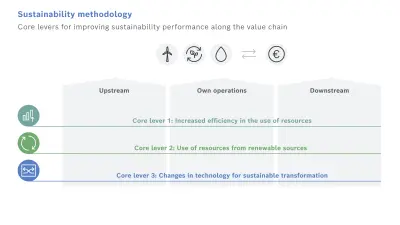
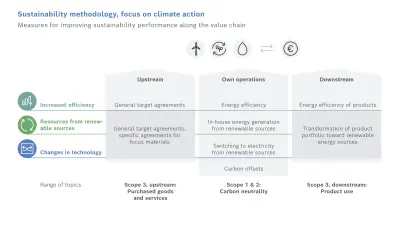
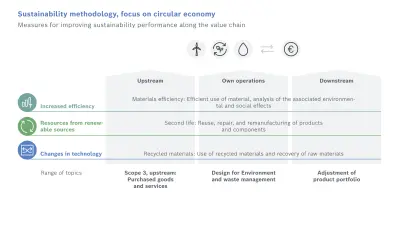
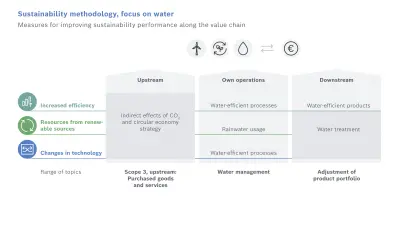
In this way, we create transparency with regard to the impact of the different measures, we show the relationships and interactions between the various influencing factors — and we thus provide the basis for in-depth scenarios in order to capture and control the effects of decisions in their entirety. This also reveals the additional differentiation potential of sustainability topics that will be of particular importance to Bosch in the future — as illustrated by trend and market analyses.
By consistently implementing the principle of the circular economy, it is possible to combine climate action, resource conservation and greater resilience for companies and their supply chains.
Circularity for a more sustainable product portfolio
With our circular economy strategy, we want to enhance the sustainability of our products over their entire life cycle – from procurement and production to use, return, and remanufacturing, right through to recycling and reuse of materials.
To this end, we endeavor to either create loops directly within Bosch or close them outside the company using established recycling processes. This way, we reduce the amount of materials used and our products’ carbon footprint*** and contribute toward achieving our scope 3 target. At the same time, we also avoid potential risks relating to compliance with environmental and social standards. Building a closed-loop system for materials has the particular advantage of eliminating parts of the value chain that are subject to risks, such as extraction of raw materials.
*** Unless otherwise stated, carbon footprint takes into account all greenhouse gas emissions ranging from raw material extraction to transport, production, sales, and use through to disposal of the product (cradle to grave) (see DIN EN ISO 14067).
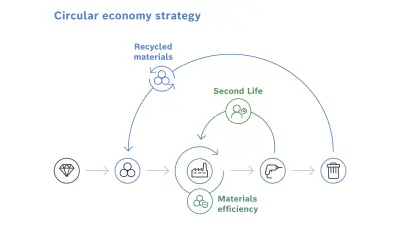
Three levers of circularity
In our circular economy strategy we use a model comprising levers that can be applied across the entire value chain. Depending on the markets in which our divisions operate, however, the levers differ in their degree of effectiveness, are not equally applicable across the board, and therefore offer different development potential.
Materials efficiency
For years, improvements in materials efficiency in production processes or products have been an essential element of our product development process, where it is anchored in an internal standard via the Design for Environment (DfE) principle. Examples of measures include the reduction of waste or material requirements for specific products.
Second life
The aim of the “Second Life” activities is to extend the life cycle of products and components. The individual divisions of Bosch each set their own priorities in this regard, depending on market and productspecific framework conditions. The concepts and activities of the divisions range from reusing products and their components to repairs and right through to remanufacturing.
Recycled materials
The third lever of our circular economy strategy — recycled materials — covers all measures to close the loop in the economy for materials such as steel, aluminum, and plastics. This way, we can reduce the use of primary materials, and lessen our environmental impact — as well as human rights risks from the extraction of raw materials. Our use of recycled materials also means that we are supporting the achievement of our scope 3 target.
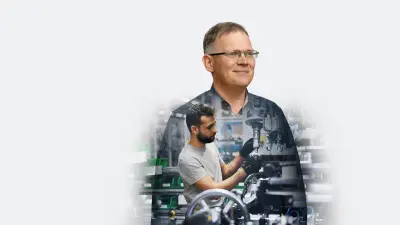
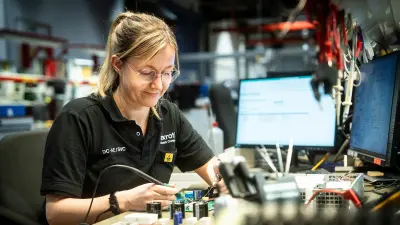
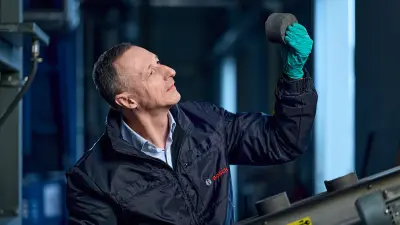

We are focusing our efforts on areas where water is particularly scarce — and are using specific solutions to create the greatest possible benefit there.
Responsible use of water
Conscientious use of water is one of Bosch’s major priorities worldwide. Since 2017, we have been working at locations in water scarcity areas to counter the increasing scarcity of water. The company locations were identified using the Water Risk Filter of the World Wildlife Fund (WWF).
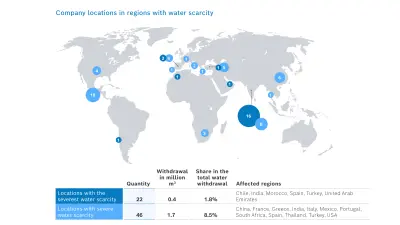
In 2025, 68 company locations in regions with water scarcity accounted for around 2.10 million m³ of water (prior year: 2.23 million m³) or 10.3 percent of Bosch’s total annual water withdrawal. This corresponds to a reduction of around 30.9 percent compared to the baseline year 2017 (prior year: 28.5 percent). We have therefore achieved our previous target – a 25 percent reduction by 2025. We have also set ourselves a new target of reducing absolute water withdrawal at 94 newly assessed locations by 7 percent by 2030 compared with our 2025 baseline year.
An annual budget of 10 million euros is available to support the achievement of our water target. In order to use the funds for achieving the water target as efficiently as possible, water coordinators from the divisions identify local savings potential and implement the measures with those responsible at the affected sites. Since 2019, more than 300 projects were launched that enable us to save up to 840,000 m³ of water at our sites each year.
-30.9 percent
Bosch has reduced its water withdrawal at locations in water scarce regions by 30.9 percent compared to 2017.
Three starting points for conservative water use
Bosch needs water for cooling systems, sanitary facilities, and technical processes. We are focusing on process improvements, recycling, and the use of rainwater to further reduce water withdrawal at our company locations.
Improve processes so that less water is needed
Improve circulation to reuse the water consumed
Use rainwater instead of fresh water
In 2025, we used around 178,000 m³ of rainwater at our locations.