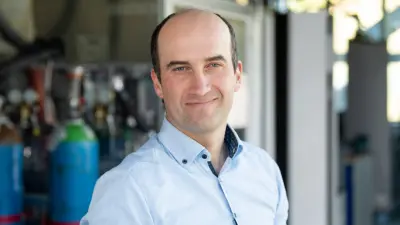
Dr. Maxime Carré
Senior expert in stationary electrochemical systems and their control
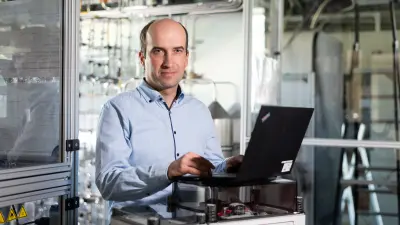
I completed a French / German mechanical engineering degree with specialism in control theory. This background offers me a broad technical and scientifical understanding, which is in my opinion really crucial when it comes to electrochemical systems. I have developed stationary fuel cell systems for 13 years and focused on electrolyzer systems more recently. As one of the research associates with the longest experience in this field, I like to describe myself as the “living encyclopedia” of stationary electrochemical systems. I am eager to continue this journey along the electrolyzer route.
Please tell us what fascinates you most about research.
In a research environment, on one hand, you have to concentrate on one or two high-level objectives to get results, often over a long period of time. On the other hand, no two days are the same because you have to tackle various challenges on the journey to this high-level goal. This contrast is what makes the job so exciting! I'm also fascinated by the pioneering spirit: the prospect of probably being the first to solve a particular problem is very motivating for me.
What makes research done at Bosch so special?
At Bosch Research, we develop products that make sense, that improve the quality of life for millions of people in a sustainable way. For me, this is the main benefit of contributing to research at Bosch and, in my opinion, the best motivator to achieve world-class results. On a more pragmatic note, I can say that the infrastructure, funding, and high-level decision processes allow us to concentrate on what matters: delivering cutting-edge scientific results.
What research topics are you currently working on at Bosch?
My team and I are currently developing a novel low-temperature electrolysis stack. While another team is dedicated to cell development, my colleagues and I are working on integrating the stack into a complete electrolysis plant. In particular, the simultaneous control of numerous electrolyzers within a single plant presents us with a few challenges — solving these is part of my research field. As an expert, I also lead various studies in the area of stationary electrochemical converters. Right now, for example, I'm reviewing the technical and economic suitability of a mobile PEM fuel cell system for stationary use. My deep system understanding allows me to derive the requirements for such systems, create synergies within Bosch, and make recommendations for future products.
What are the biggest scientific challenges in your field of research?
With regard to electrochemical systems, my biggest scientific challenge is to understand and put all the physical effects and their correlation occurring inside the system into simple equations. Although I have been working on this topic for almost 13 years, I keep discovering new effects. Putting this into equations makes it possible to develop robust and fast control algorithms.
How do the results of your research become part of solutions “Invented for life”?
Fuel cells and electrolyzers are two essential products for a CO₂-free society. Climate change is not just a discussion anymore. This means for me, that each step in the development of these products at Bosch Research is automatically a step toward a more sustainable world, a step toward electrochemical “Technology for a sustainable life.”
Curriculum vitae
Since 2011
Research engineer at Bosch for stationary electrochemical system
2008
Ph.D. at Bosch on the control of stationary solid oxide fuel cells
2006
Degree in technical cybernetics in Stuttgart
2005
Development aid project in South America
Selected publications

Bosch et al. (2017)
- Timo Bosch, Maxime Carré, Angelika Heinzel, Michael Steffen, François Lapicque
- Journal of Power Sources 371, 197 - 208
Wahl et al. (2015)
- Stefanie Wahl, Ana Gallet Segarra, Peter Horstmann, Maxime Carré, Wolfgang G Bessler, François Lapicque, K Andreas Friedrich
- Journal of Power Sources 279, 656 - 666
Carré et al. (2015)
- Maxime Carré, Ralf Brandenburger, Wolfgang Friede, François Lapicque, Uwe Limbeck, Pedro da Silva
- Journal of Power Sources 282, 498 - 510
Maxime Carré (2012)
- Der Andere Verlag
Get in touch with me
Dr. Maxime Carré
Senior expert in stationary electrochemical systems and their control