Good — better — Bosch
History of advertising campaigns at Bosch
Advertising has been around for thousands of years. For Bosch, promoting a product or service with the help of visuals or slogans has become increasingly important and sophisticated over the course of the company’s history. A look at the advertising campaigns of the last 120 years illustrates this evolution.
Robert Bosch and advertising
“There is no doubt that advertising is necessary. How much advertising you need, however, is a matter of opinion. I myself am aware that I have made a greater impact with the quality of my products than with advertising.” Robert Bosch seemed very sure of himself with this assessment in 1931. But without the corresponding advertising, some customers around the world would probably never have become aware of Bosch products, and thus would never have had the chance to experience the benefits of their quality.
The first advertising campaign
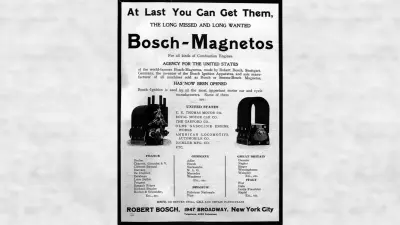
Nonetheless, since Robert Bosch had a good sense for finding “the right people for the job,” he hired capable individuals who knew how Bosch advertising could be used most effectively. For many years, his nephew Hugo Borst was in charge of the company’s first major advertising campaigns. A large-scale advertisement in U.S. newspapers and magazines enabled Bosch to enter the American market.
Posters with lasting impact
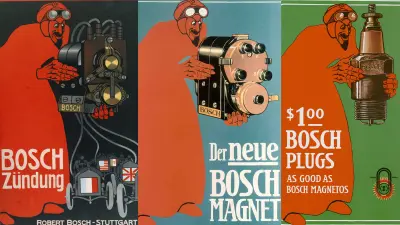
At about that same time, companies were commissioning well-known commercial artists to design posters. Around 1909, the graphic artist Julius Klinger created the advertising figure of the “red devil.” He was inspired by the famous Belgian racing driver Camille Jenatzy, who won major car races with his fast driving and Bosch magneto ignition.
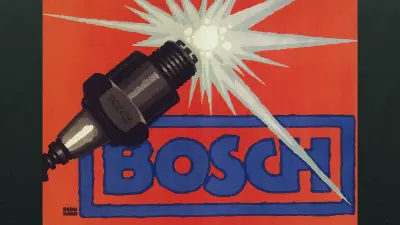
In 1912, the commercial artist Lucian Bernhard received his first commission from Bosch and was tasked with giving the company a new, uniform image. As the “originator of the Sachplakat,” or object poster Bernhard used a simple, clear visual and written language and reduced the poster to a depiction of the product with the name of the product or manufacturer. The first motif designed by Lucian Bernhard was the legendary spark plug with exploding spark, which dominated Bosch advertising for a long time.
Advertising was never more important
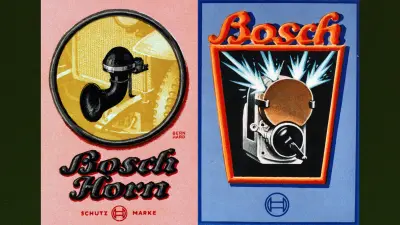
Advertising became particularly crucial when launching a new product or opening up a new market. Bosch had an impressive track record in this area up to the outbreak of the first world war in 1914. After the war was over, the situation was very different. Some markets had to be reopened in the aftermath of the war and Bosch first had to attract attention again.
The posters by the Bernhard-Rosen graphic design studio in Berlin provided an impressive visual setting for the products. Now, however, a suitable advertising slogan had to be found that was the right fit for Bosch.
A lot of ideas
The previous “Bosch ignition is the best” no longer fit, as the company now offered many other automotive products alongside ignitions. Bosch’s advertising department, which had become increasingly professionalized after it was established in 1910, launched an appeal in the in-house newspaper “Bosch-Zünder” for associates to send in suggestions.
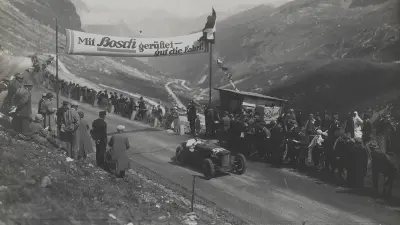
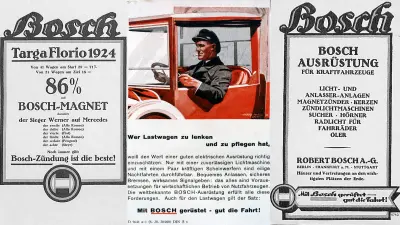
“A calm drive with Bosch” or “A car without Bosch lights, ignition, or horn is in bad shape!” — almost 50 suggestions were submitted. The one that ultimately won out was “Equipped with Bosch – a good journey.” The slogan remained dominant in German-speaking countries until the early 1950s. In some advertisements, it was supplemented by “Bosch gives you more — performance, safety, and value.”
New message in advertising
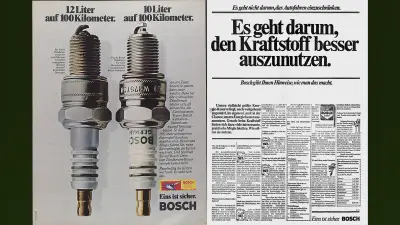
The slogan “One thing is sure. Bosch” also began appearing more and more as a pithy way to highlight the notions of safety and reliability. From the late 1960s onward, however, it became apparent that, in addition to convenience and safety, other factors were gaining importance in the ever-increasing volume of road traffic. Air pollution and global crises resulting in a shortage of raw materials were important drivers for reducing fuel consumption and emissions. Bosch offered the right products for this, and the slogan “safe — clean — economical,” which had been formulated in house as a Bosch development goal in 1973, had to be translated into advertising. This was no easy matter, particularly in the automotive sector; Bosch products were “hidden” under the hood when installed as standard, where they couldn’t immediately catch the eye of the car buyer.
Advertising from the 1990s
Bosch and the solution
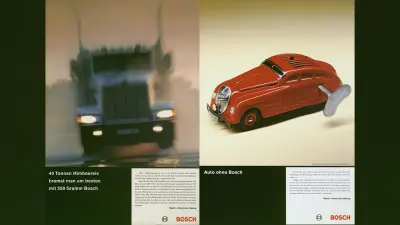
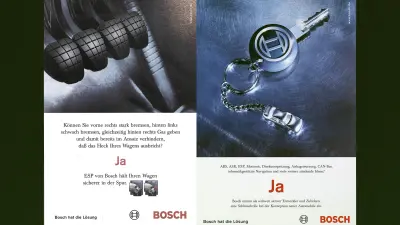
With the slogan “Bosch — always a solution,” an advertising campaign was launched in the 1990s that brought the “hidden” Bosch products into the limelight. The most striking example was the “car without Bosch”: it depicted a windup car and speculated what would happen if all Bosch components were removed from a car. The only remaining option would be to push it along. A short time later, the advertising slogan was adapted to “YES — Bosch has the solution.” The “YES campaign” also featured a series of ads created by the Bosch advertising department, which showcased Bosch products such as ESP with unusual images — for example, four gas pedals in the footwell.
Advertise “LikeABosch”
What Bosch was lacking was an all-encompassing advertising strategy that could work for all business sectors. The “LikeABosch” ad campaign launched in 2019 not only gave advertising at Bosch a whole new direction, but it could also be applied internationally and in all company areas. It focuses on smart products and solutions that make everyday life and manufacturing easier and more efficient. The campaign, developed by the Bosch advertising department in collaboration with the Jung von Matt agency, significantly changed the public’s perception of the company and led to top rankings on YouTube advertising charts and to winning Germany’s Best Brands Award in 2021.

Author: Christine Siegel