Batteries, not cables
The history of Bosch cordless power tools

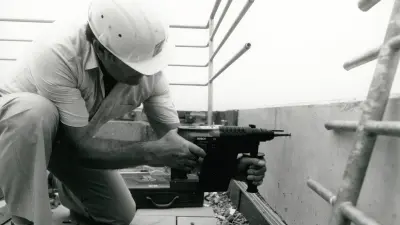
Without a nearby electrical outlet, operating a power tool used to be difficult; an extension cable can only reach so far. In 1969, Bosch launched its first cordless tools — and from these modest beginnings it gradually developed a comprehensive range of tools for professionals and do-it-yourselfers.
It’s sunny out in the garden, and shaping the hedges close to the house is no trouble at all with an electric hedge trimmer. But the hedges at the back of the garden are too far for the power cord to reach. Likewise, on the construction site next door, there’s no electricity to be had up at the top of the scaffolding, as it would be too dangerous to lay cables there. With these and similar situations in mind, the engineers at Bosch set to work.
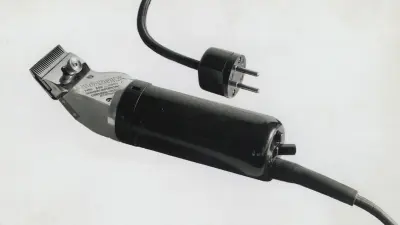
The new Bosch power tools should be handy and easy to use. As long ago as 1928, the company had launched an electric hair trimmer. With its principle of the “motor in the handle,” this small appliance became the starting point for the new product division. Power tools were always difficult, if not impossible, to use when there was no electrical outlet nearby — especially on construction sites, in gardens, and in the great outdoors. In difficult working positions, too, such as on scaffolding, in containers, or in installation shafts, it’s often not possible to lay a power cable. So what could be more obvious than housing a tool’s power source inside the tool itself?
Heavyweights
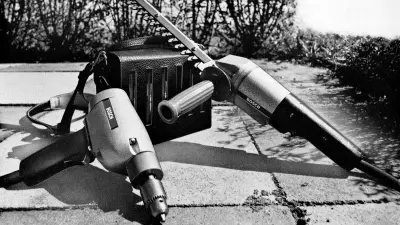
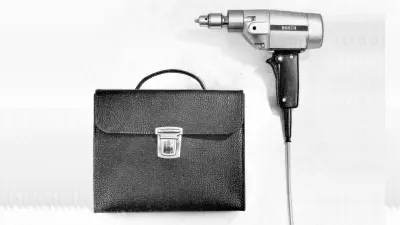
Until the 1960s, the most reliable battery technology was the lead-acid accumulator, as used for the starter batteries in motor vehicles. Such batteries could deliver sufficiently high currents, but the recharging process was tricky. Because of the liquid components, namely the sulfuric acid electrolyte, care had to be taken with the batteries’ positioning, and it wasn’t possible to operate them upside-down. Moreover, as a heavy metal, the lead in the battery weighed quite a bit. Although nickel-cadmium batteries were already available that were lighter and could be installed in any position, their performance was insufficient for most applications. That’s why the first two cordless power tools that Bosch launched in 1969 used a lead battery. The power drill and the hedge trimmer each came with a battery bag that users could sling over their shoulder. But weighing in at 5.5 kilograms, the shoulder bag and its cable connection to the tool made both products cumbersome to use, although the hedge trimmer could cut 20 meters of hedge in one hour of continuous operation.
Handy and compact
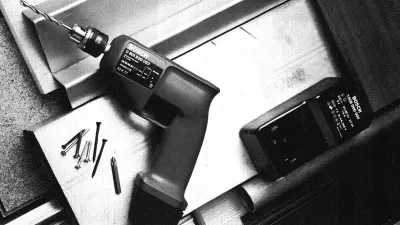
However, the idea of using a battery to operate power tools was fundamentally appealing, and Bosch continued its development work. Just under five years later, the company launched its first tool to feature an integrated rechargeable battery: grass shears. The shears made use of a new battery-cell technology comprising a dry battery with four nickel-cadmium cells. This delivered high energy density and a long service life over many hundreds of charging cycles. In 1982, Bosch followed up with its first battery-powered drill: a small, lightweight, and handy tool that could be recharged within an hour using the associated quick charger.
World’s first
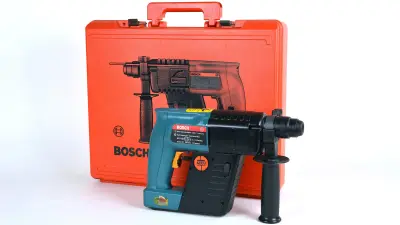
Bosch reached a milestone in 1984 with the world’s first cordless hammer drill. Initially aimed at professional users, the GBH 24 V let them work far away from any electrical outlets, from the top level of scaffolding to deep underground for caving. It was built around a very powerful dry battery with 20 nickel-cadmium cells: on a single charge, tradespeople — or cavers — could drill over 60 holes.
Battery expertise
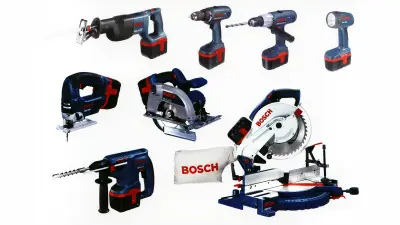
Over the years that followed, improvements in the battery technology made the tools more and more powerful. In 1998, Bosch presented two cordless drill drivers with 14.4 and 12 volts, which were the first to use a new cadmium-free cell technology. The nickel metal hydride battery packs were lighter and more compact than nickel-cadmium batteries, and they also offered significantly higher capacity.
The next leap in performance came with the introduction of the 24-volt battery system in 2000: now, the battery technology could also be used in tools that had previously run only on grid power. Bosch launched four professional tools: an impact drill and a drill driver with very high torque, a reciprocating saw, and a work lamp.
Success with lithium-ion technology
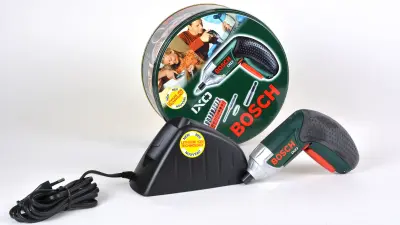
In 2003, Bosch launched the IXO, a small, compact screwdriver that fit comfortably in the palm of the hand. Most importantly, it showcased a new technology: a lithium-ion battery. The company was the world’s first manufacturer to use lithium-ion batteries in a power tool — with the major advantage of no self-discharge and no “memory effect,” or loss of capacity as a result of recharging before the battery is fully discharged. The new battery cells were also up to 40 percent lighter than nickel-cadmium cells, meaning the IXO weighed in at just 300 grams.
Powerful rechargeable batteries for all tools
Further development work in the following years focused on the new lithium-ion technology. In 2005, Bosch launched a 36-volt battery system. Tools equipped with this system could perform large and heavy jobs on a construction site just as reliably as grid-operated machinery. Lithium-ion batteries gradually found their way into more and more types of power and garden tools; they have also featured in the cross-manufacturer 18-volt systems of the battery alliances for DIY tools since 2020 and professional tools since 2022.
Since 2023, Bosch has been the world’s first supplier to implement “tabless” battery-cell design in 18-volt batteries. Conventional lithium-ion batteries are designed with “tabs,” or bottlenecks through which the current must flow. Tabless cells offer multiple paths for the current to take, thereby reducing the resistance of each individual cell and of the entire battery pack. Consequently, less heat is generated and the battery remains powerful and operational for much longer, especially in demanding applications. What hasn’t changed — and is as valid as ever — is the goal that Bosch has pursued ever since it first began manufacturing power tools, whether corded or battery-powered: to develop tools that are flexible, easy-to-use, and offer lasting performance.
Author: Bettina Simon